Showing posts with label Breakout Past. Show all posts

Thursday, September 5, 2013

Breakout Past: Shaffer Ice Palace

Last September, in the build-up to Penn State's first modern varsity games, Breakout Past examined the last first varsity game for PSU hockey, a 3-1 win over Carnegie Tech on December 6, 1940. The venue for that contest was the Shaffer Ice Palace in Johnstown.

With Penn State now about to move into Pegula Ice Arena, it's probably as good of a time as ever to take one more look back at that "home" rink.

Ad in the December 12, 1939 Altoona Mirror

The history of Shaffer Ice Palace was outlined in last year's post, but just to review: Frank M. Shaffer owned Johnstown's pre-eminent ice-making business in the early decades of the 20th century. By the late 1930s, however, artificial refrigeration had made Shaffer's outfit obsolete. So he decided to combine his facility at the end of McMillen Street with his knowledge of ice and open a rink.

Following its December, 1939 initiation, Shaffer was home to numerous events including hockey, ice shows and even boxing. In the 1941-1942 season, it gained a primary tenant in the form of the Johnstown Blue Birds of the old Eastern Hockey League. And of course, there were the Nittany Lions who, between February 6, 1940 and January 17, 1942, played at least eight of their 16 total games there, going 5-3-0 in those matches.

Shaffer Ice Palace interior. Photo: Vintage Johnstown

The Blue Birds, although successful on the ice, going 34-20-6 and tying for first in the standings, were a disaster off of it. Owner Bill "Pick" Hines had made the money to buy the team on a horse racing bet and his lack of true wealth, combined with poor attendance, came to a head almost immediately. Throughout the year, Hines was unable to make payroll and required outside cash infusions to help get the Blue Birds get through. The unstable team met its end shortly after its sole campaign when the Ice Palace was converted for manufacturing purposes supporting the U.S. effort in World War II, which began in the middle of the season with the attack on Pearl Harbor.

While it would be a stretch to call the demise of Shaffer a major factor in Penn State's varsity team eventually sharing the same fate, the loss of an available central PA sheet certainly didn't help. PSU would only play 11 more varsity games after that 1941-1942 season and, largely thanks to WWII gas rationing, only one at the Hershey Sports Arena, the other most frequent venue from those days. The reasons hockey didn't work out at that time are many and varied, but most trace back to the war in one way or another, whether it be the need for able-bodied young men overseas, materials restrictions that hampered plans for an on-campus facility, or, obviously, the choking off of the team's existing rinks in one way or another. Since college programs across the nation faced similar issues, with many suspending their teams for the duration, further complexity was added to the already-difficult scheduling process.

Duquesne Gardens in Pittsburgh is long gone. So is the original Ice Pavilion and the Mechanicsburg Skatium, PSU's temporary outpost after the Icers' first rink was re-purposed as a later-demolished field house in 1978. There are no longer tennis courts to flood across Curtin Road from West Halls, the Thompson Spring Winter Sports Park was abandoned and Beaver Field, both New and Old, gave way to development decades ago. Setting Pegula Ice Arena aside for a moment since it hasn't hosted a game yet, the only remaining structures that could have been considered a home (or potential home) for Penn State hockey are the "new" Ice Pavilion, what is now called Hersheypark Arena...

...and the Shaffer Ice Palace.

Yep, somehow, in an era that produced and then discarded ice rinks at a staggering rate (another example: Huntington, WV's Iceland Arena, which also hosted a PSU game during the original varsity era), the site of what will always be the Nittany Lions' first varsity game is still there.

It's neighborhood has deteriorated significantly since 1940, as what was once a sturdy working-class area has been largely abandoned and left for dead by relocated industry. But two functioning businesses do bookend the building. One is Jack Brown Wholesale, which actually uses the place to help sell siding, shingles and other things that would be useful to the surrounding residences.


Then, after following a side that runs along an alley called Bell Place...


...on the opposite end is the salvage yard for Brat Towing & Recovery, Inc. Unfortunately, Brat's fence prevents a better view, but I suspect that this is closer to what the building looked like 70-plus years ago.


In the postwar years, 1950 to be exact, Johnstown would become home to the Cambria County War Memorial Arena. Upon its completion, the EHL returned in the form of the Johnstown Jets. That team would last until 1977 and deliver the inspiration for Slap Shot, a film shot in town (including at the War Memorial), giving Flood City a healthy degree of hockey celebrity status. Since the Jets, the arena has hosted the ECHL's Johnstown Chiefs - a team whose alumni include Icers Mark Scally, Justin Depretis, Bill Downey and Curtiss Patrick - from 1987-2010 and, beginning last season, the NAHL's Johnstown Tomahawks.


While Penn State's history at the War Memorial isn't extensive beyond the Icers-to-Chiefs connections, it's worth mentioning nevertheless. The 1983-1984 national championship team played there six times, including twice each against Alabama-Huntsville and Notre Dame (both of which are now in NCAA Division I), as well as against Arizona.

Wednesday, August 14, 2013

Breakout Past: Team of Destiny

Joe Battista with 2001 seniors (left to right) Greg Held, Alon Eizenman and Mike Blevins

The 2000-2001 Icers could probably be considered the peak of PSU's early-2000s ACHA dynasty. By that season, winning had become more coldly efficient than stunning (as it had been the year before). It was also the only intersection between one of the greatest players in ACHA history, Alon Eizenman, and a couple other holdovers from the 1998 Murdoch Cup winners with guys like then-freshmen Glenn Zuck and Curtiss Patrick, junior Neal Price and a sophomore class that would go on to win titles in each of its four collegiate seasons.

Predictably, Penn State steamrolled its way to a 24-4-2 regular season, losing only to CIS school York on the road, in overtime at Ohio, and a December Ice Pavilion sweep at the hands of Eastern Michigan by a pair of 4-3 scores. The Icers won both in-season tournaments on the schedule, the Two Nations Cup over CCAA programs Seneca and Carleton, and the Nittany Lion Invitational by a combined 17-0 blowout of Navy and West Chester.

The national tournament that year was hosted by Arizona. PSU entered as the second seed (predictably, behind EMU) and cruised through Pool B by beating Kent State 6-2 and the host Icecats 8-3. However, the Icers were the only team in the top four to advance to the semifinals as Illinois trumped No. 3 Minot State, Iowa State took down No. 4 Ohio and, most shockingly of all, the Josh Brandwene-coached Delaware Blue Hens beat top-ranked EMU 6-5 on the first day of the championships and went on to win the group. With the other favorites out of the picture, Penn State made short work of Illinois (7-3) and Delaware (7-2) to take the crown for the second time in a row and the third time in four years. Sure it was aided by the upsets, but nothing closer than four at nationals? That's pretty dominant.

Former Johnstown Chief Bill Downey is among the 2000-2001 Icers still involved with hockey

By ACHA standards, a ton of players from that team went on the play professionally, including Zuck, forward Bill Downey, defenseman Josh Mandel and goaltenders Scott Graham and Brian Gratz. Eizenman and Patrick were particularly noteworthy in that regard, with the former playing in Israel and France (and internationally with the Israeli team) for six years and Patrick (of the Patricks, for those unfamiliar) enjoyed a five-year career primarily in the ECHL but also including 11 games and two assists in the AHL.

That was then. What about now? Beyond the investment brokers, lawyers, doctors and web developers in the group (and there are plenty of people that have done very well in a wide range of fields), what of those still involved with hockey?

Click to enlarge

Head Coach Joe Battista (front row, center): Associate Athletic Director for Ice Arena and Hockey Development, Penn State

Assistant Coach Dave Bauer (middle row, fifth from left): Head Instructor, Bauer Hockey Training Center

Assistant Coach Darren Hersh (middle row, third from left): Goaltending Coach, Reading Royals (ECHL), also Instructor, Goalie Academy

Bill Downey (back row, sixth from left): Director of Operations, Penn State Men's Hockey

Ryan Patrick (middle row, sixth from left): Hockey Director, Pegula Ice Arena

Geoff Beauparlant (front row, second from right): Head Coach, Kenai River Brown Bears (NAHL)

Joe Sheridan (back row, fifth from left): Assistant GM, Wells Fargo Center

Brian Gratz (front row, far right): Head Coach, Bloomington Thunder (SPHL)

Thursday, June 13, 2013

Breakout Past: Battista Scouts The Cyclones

At the conclusion of a 19-6-3 1989-1990 regular season, Joe Battista's third as Icers coach, Penn State entered the 1990 National Invitational Tournament in Athens, OH as an uncharacteristically heavy underdog. PSU was the sixth seed (of eight), and also faced a pool including host Ohio, a 24-1-0 team that hadn't lost at home in three years. No big deal. John Gray's 49 saves included a shutout of the Bobcats over the final 40 minutes and John Ioia's power play goal was the winner in a 5-3 victory on March 1, 1990, following a 6-5 win over Arizona in the tournament's opener.

Beating OU clinched first place in the Icers' four-team group and a berth in the championship game, so PSU mailed it in the next day and lost 7-1 to Wisconsin-Whitewater. It wasn't time off for Battista though, as he scouted an Iowa State-North Dakota State game in the opposite group that determined the other participant in March 3rd's final. Via Special Collections at the Penn State University Libraries, here are the notes he took during the game. Click to enlarge.


One thing seems pretty clear: Battista viewed ISU as a spent team. Before the first intermission, he observed that they "slowed considerably in [the] 2nd half of [the] period. In the latter stages of the second period, he wrote "both teams appear very tired," and by the beginning of the third period, he believed that NDSU "has more left," that the Cyclones' "goalie is tired" and that one of Iowa State's forward lines is "out of gas."

A lot of that may have had to do with how ISU coach Al Murdoch had the team playing. Other notes on his team pointed out their aggressive forecheck, quick transitions, and individualistic tendencies, along with the fact that the game at hand was played with a lot of pace, requiring quick changes. Battista didn't seem to be a fan of the Cyclones' blueliners, classified as big and slow, fond of taking chances, and able to be beat with speed, as happened on a late first-period goal by the Bison. Towards the end of the game, and spanning the columns for both teams, Battista wrote that PSU's opponent "will subconsciously lighten up knowing OU is out."

So... what to do with all of that knowledge? Easy. Apply it to your last-minute coaching before Penn State battled the Cyclones for the national championship.


It's simple to find where Battista incorporated his ISU-NDSU observations:
  • "Subconsciously they may let down after their win over NDSU. Also because they're not playing OU."
  • "Will they have enough left after yesterday? Third game in three days for their goalie - tired!"
  • "Change quickly, keep them off balance."
And here's one for fans of the Miracle on Ice:
  • "This is our 'Finland' game. We already beat the Russians now we have to finish what we came to do!"
At the very top of the page, Battista reminds himself to get a letter from "Paul," meaning former Icers faculty advisor Dr. Paul Cohen. Here is that letter.


The legwork ultimately proved successful, of course, as Andy McLaughlin scored with just over three minutes remaining to boost Penn State over the Cyclones 4-3. Midge Hutchison, Chris Cervellero and Jim Adams also scored, while Gray made another 35 stops. Afterwards, what PSU's head coach told The Daily Collegian should be obvious to anyone who has read this far.
"Iowa State was a better hockey team on paper," Battista said. "We knew they were tired though from their Friday night game against North Dakota State."
I'd argue that, in fact, Penn State was the better hockey team on paper, provided that the paper comes from a standard-issue legal pad.

Wednesday, June 5, 2013

Breakout Past: Penn State vs. Georgetown, 1/24/1942


Today's starting point, quite obviously: a pass for Penn State's January 24, 1942 game against Georgetown, a part of Penn State University Libraries' Special Collections, just to get the credit in right at the top.

It's not really a "ticket," per se, based on the fine print. This document was to be exchanged, along with fees and taxes, for a ticket at the box office at Riverside Stadium in Washington, DC. It was issued by Riverside's advertising department, so it's probably fair to call it a promotional effort - hand out a bunch of passes to get people in the door, then hope they all buy peanuts.

To support that view, the pass also included an attached note.


Unfortunately, a search for more on Joseph E. Rice was fruitless (he may have attended PSU circa 1919, but that's unconfirmed), but the generic greeting and stated goal gives off the impression that Rice flooded the Penn State community in DC with passes and hoped a few would show at the game.

The Daily Collegian offered unusually robust coverage of this one, as judged against the standards of the time, including a preview story on game day:


Handicapped by thawing weather conditions which have kept them idle for the past week, the Lion stickmen will seek to upset a favored Georgetown University squad tonight in Riverside Arena, Washington, DC.

Undefeated, untied Georgetown boasts a veteran lineup which has averaged the astounding record of eight goals per game in [four] victories this season. Last week, they humbled a strong University of Pennsylvania team, 4-1.

Tonight's lineup will again have Captain Larry Lightbody guarding the nets, and Bert Anthony and Tom Goodwin at the defenses. Mike Fedock and Earl Johnson will fill the wing spots, and Johnny Dufford will be at the center position.


As both the Collegian and the pass note, the game was contested at a facility called Riverside Stadium, situated along the Potomac in the northwest quadrant of Washington. Constructed in 1938 and 1939 as the United States recovered from the Great Depression, Riverside was a massive complex that hosted all manner of sport in its time. The main arena seated approximately 6,500 for basketball (roughly 1,500 fewer for hockey) was briefly home to the cagers from both Georgetown and George Washington Universities in the early 1940s, as well as a professional hoops team in the American Basketball League called the Washington Heurich Brewers, after a neighboring brewery. An adjacent football field hosted the DC public schools' football championship, and boxing and roller skating were also big draws at Riverside. And of course, there were frozen-water events like the Ice Follies, the Washington Eagles of the old Eastern Hockey League, and Georgetown's team, which began play in the 1938-1939 season before gaining university support the following year.

Riverside Stadium's heyday was remarkably short-lived - only about four years or so - thanks largely to competition from the cross-town Uline Arena, which opened in 1941. Uline, among other things, hired away Riverside's arena manager, then brought in an American Hockey League team (the Washington Lions) that helped force the Eagles out of business in 1942. Uline, which became the site of the first U.S. concert by The Beatles in 1964, stole college hockey as well, as both of the Nittany Lions' contests in the national capital following 1942 took place there. By late 1951, when the federal government sued to take over Riverside to house the then-new CIA, it was used exclusively as a roller rink. The CIA departed for Langley, VA in 1961, and both Riverside and the Heurich Brewery were razed to make way for the John F. Kennedy Center for the Performing Arts, the Watergate complex and the jumble of freeway ramps that surrounds the area.

Before discussing the specifics of the match, I need to let you know that the three accounts I have - the Collegian, the Washington Post and the Washington Star - differ from each other in many respects. Lineups, times of the goals, identities of those with assists and penalties, and even the sequence of the goals (according to the Post, PSU tied the game at one before GU went ahead 2-1, while the other two say the Hoyas were up 2-0 at one point) are inconsistently reported. All three agree on the goal scorers, but that's about it. Rather than give you three different versions of the same events, I've tried to identify the most likely truth on a case-by-case basis, usually helped by consistency between two of the three write-ups, but admittedly sometimes based on gut instinct.

Georgetown's Bill Deegan (center) paced the Hoyas' attack

Anyway, the game itself, at least from the Penn State perspective, mirrored Riverside Stadium's life in that a promising start against the powerful Hoyas fell apart quickly and definitively in the late going. While Georgetown jumped out to a 2-0 first-period lead thanks to goals from Bill Deegan and John Cassidy, PSU battled back through Ted Cauffman and Earl Johnson to level the game headed into the third period.

Then Deegan took over.

The senior, who (according to the Post) was set to join the Marine Corps after graduation - remember, Pearl Harbor was less than two months before this game - ripped off a natural hat trick in the third period, giving him four goals in all and putting the game out of the Lions' reach. In the days before the late-1950s Montreal Canadiens inspired the now-taken-for-granted rule that ends minor penalties after a power play goal, Georgetown scored four times with the man advantage according to the Collegian, despite the fact that PSU only took three penalties all game long (given the times of the goals, it seems likely that the first four Hoya scores, possibly occurring during just two different PSU penalties, were the ones referenced). John Dufford pulled a late goal back from Johnson's assist, but it only served as window dressing.

Here's an attempt at a box score - once again, sort of a composite of three varying accounts.

Lineups
Penn State
Goal: Lightbody; Left Defense: Anthony; Right Defense: Goodwin; Center: Dufford; Right Wing: Johnson; Left Wing: Fedock; Spares: Steva, Cauffman, Templin, Burford, Fisher, Hill, Heberling, Sussman.
Georgetown
Goal: O'Neill; Left Defense: Perpich; Right Defense: Yukna; Center: Deegan; Right Wing: Cassidy; Left Wing: McQueeney; Spares: Conway, Routh, Werder, B. Burnet, J. Burnet, Pander, Fullam.
First Period
Scoring
1. Georgetown, Deegan (J. Burnet), 7:45; 2. Georgetown, Cassidy (Pender), 8:15; 3. Penn State, Cauffman (Dufford), 10:45.
Penalties
1. Penn State, Johnson (tripping); 2. Georgetown, Perpich (tripping).
Second Period
Scoring
4. Penn State, Johnson (Fedock), 15:02.
Penalties
3. Penn State, Johnson (tripping).
Third Period
Scoring
5. Georgetown, Deegan (Pender), 7:10; 6. Georgetown, Deegan (Cassidy), 8:10; 7. Georgetown, Deegan (Cassidy), 17:50; 8. Penn State, Dufford (Johnson), 18:30.
Penalties
4. Penn State, Fisher (tripping); 5. Georgetown, Conway (interference).

"The Best College Hockey Game of the Season," as hyped by the pass? Maybe not, but regardless, the defeated Penn State squad garnered respect. According to the January 28, 1942 Collegian, "the Lions were adjudged 'the strongest visiting collegiate team' to play in Washington's Riverside Stadium thus far this season."

This Washington Star photo of the game was captioned: "Goalie Larry Lightbody of Penn State took this shot by John Conway (6) of Georgetown on his cranium in order to save a point. It was useless pain as the Hoyas carried off the laurels, 5 to 3, at Riverside last night.

Mr. Rice, by the way, was extremely successful in his attempt at getting a good crowd to the game. Attendance figures given ranged from "more than 4,000" (Star) to 4,600 (Collegian), with the latter account stating that 1,000 Penn State alumni were there. Six weeks after the game, the Post (which revised its initial count of 4,200 to 4,600 by that point) called the throng the largest ever recorded for a hockey game at Riverside Stadium and, in previewing PSU's return to DC to face the Navy All-Stars on March 10th of that season, said that Penn State "has established itself as far and away the best collegiate box office attraction to ever appear on local ice." Toss in the fact that Georgetown's band was at the game, and it's probably not a stretch to call the affair one of the great atmospheres in Penn State hockey history, even today.

Georgetown improved to 5-0-0 with the win, while the loss dropped the Nittany Lions to 1-2-0, although Art Davis' charges would go on to win four of their final five games to finish 5-3-0. Perhaps the commencement of U.S. involvement in World War II made it predictable, perhaps not, but following the season, the 1940-47 varsity era included just nine more official games, with only two of those ending in wins.

Friday, May 17, 2013

Breakout Past: Who Wants to Marry an Icer?


On February 15, 2000, over two hours in Las Vegas and in front of 22 million viewers on Fox, Californian Darva Conger won a beauty pageant-style competition against representatives from the other 49 states for the right to marry Rick Rockwell. Rockwell, then 42 years old, was vaguely hyped by the network as a very wealthy man, although little was known about his background or what, exactly, made him wealthy. The victorious Conger also received $100,000 in prizes, including a $35,000 engagement ring.

The television special, called "Who Wants to Marry a Multi-Millionaire?" and immediate viewership success aside, was almost universally panned. One side of the political spectrum mourned for family values, while the other fixated on the show's exploitation of women. Just about everyone expressed concern for the direction of society in some form or another.
The show was an equal-opportunity offender: Everyone from the left-leaning National Organization for Women to L. Brent Bozell's right-wing Media Research Center was disgusted. "It took something like this to make the Miss America Pageant look good to me," says NOW president Patricia Ireland.
"Multi-Millionaire's" legacy today is crystallized in "worst ever" lists. In 2010, Entertainment Weekly named it the fourth-worst reality show ever and TV Guide has called it the 25th-worst show of all time.

The marriage between Rockwell and Conger, predictably, was annulled less than two months later and not very amicably. Conger, in particular, hit the talk show circuit after the fact to make clear to as many people as possible that the program was contrary to her morals, that she never had sex with Rockwell and that the entire thing was more or less a completely horrible experience for her. Shortly after, she posed for Playboy and beat up Olympic gymnast Olga Korbut on Celebrity Boxing (1, 2, 3), the latter payday giving Conger the rare distinction of appearing on two different shows from the TV Guide list. Today, Conger is back in relative obscurity, save for the occasional "where are they now?" article, as a Northern California nurse.

Rockwell did not escape the sometimes punishing glare of the spotlight unscathed. The most damaging item that came from the inevitable prying into his background was the discovery of a restraining order filed in 1991 by Debbie Goyne, a former fiancee of Rockwell's, who alleged abuse (the restraining order becoming public torpedoed re-airings of the show, along with planned follow-ups and spin-offs).

His finances were also called into question. Rockwell, in the 20 years prior to "Who Wants to Marry a Multi-Millionaire?," worked as a stand-up comic notable for outlandish attempts at publicity, a motivational speaker and a movie writer and actor who dabbled in real estate. People who are very successful at those things are generally multi-millionaires, but Rockwell's high points in Hollywood were a significant-but-only-for-our-purposes (and uncredited) turn as Steve Christoff in the 1981 TV movie Miracle on Ice and works of art like this:


The public was generally satisfied by Fox's claim in response to the criticism that Rockwell had a net worth of just over $2 million (with $750,000 of it liquid), barely meeting the "multi-millionaire" threshold, but still well short of the hype leading up to the show. Over the last 13 years, he's more or less dropped out of showbusiness and has worked as a flight instructor in San Diego. In perhaps the ultimate display of just how fleeting those 15 minutes can be, he has just 42 followers on his Twitter account.

One detail about Rockwell's background that remained relatively unknown throughout the episode: he played for the Icers.

Rockwell, whose birth name was Richard Balkey, is a Pittsburgh native and a Fox Chapel Area High School alumnus who graduated from Penn State with a health and fitness degree in 1979.
Even then, Mark Horgas, who played ice hockey with him [at PSU], noticed his former teammate's desire for the spotlight. Like the time the team was at a hotel near Philadelphia and Rockwell went onto the empty stage in the lounge to regale guests with his comedy.

"He had this joke routine pretending to be Jackie Stewart, who was this race car driver, and this safecracker routine, you know, making a noise like the dial spinning. That was just Rick," Horgas said.
Balkey in the 1979 La Vie
Balkey gave other indications of his future while an undergrad. As a Sigma Pi brother in 1978, he won the fraternity division of the Phi Psi 500 (a former PSU tradition popular during the 1970s and 1980s that involved people racing to drink in several bars, often in crazy costumes, and raising money for various charities - here's some video taken from 1982's version). The previous year, he put on a hideous bikini to help Sigma Pi win first place in a 1930s bathing beauty contest generating more than $500 for Sight Conservation and Aid to the Blind.

His two-year career (1976-1978) as a checking left wing for the Icers was really only notable due to events 20-plus years after the fact, but a couple of highlights occurring one week apart are worth mentioning. He scored the eventual game-winning goal in a 4-2 Mid-Atlantic Collegiate Hockey Conference semifinal victory against Villanova (then the Icers' biggest rival) on March 12, 1977. In a three-game spring break series against the University of New Brunswick March 3-5, 1977 treated as a tune-up for the conference tournament, Balkey tallied four times and added an assist in a Penn State sweep. In all, the Icers went 29-14-5 with Balkey on the roster, winning a pair of MACHC regular season titles.

Someday, millions will undoubtedly watch a Penn State hockey alumnus participate in the Stanley Cup playoffs. But even once that happens, it will take an awful lot to top the television splash made by Rick Rockwell.

Thursday, April 25, 2013

Breakout Past: Penn State vs. Lehigh - 12/12/1976


Somewhat surprisingly, given its location in Bethlehem, PA and its long history playing hockey, Lehigh University doesn't really have much overlap with Penn State through the decades, just 16 games in all.

The teams met twice, in 1939 and 1940, during the era when the so-called "informal team" that would eventually lead to PSU's first varsity attempt represented the university (the latter of these two meetings was actually a conference game, in the Pennsylvania Intercollegiate Hockey League that only lasted one season). After the Nittany Lions gained official recognition, two more games followed, in 1941 and 1942. Each of these first four contests was played at the famous HersheyPark Arena (then called Hershey Sports Arena) and each was won by Penn State.

After that though, the two programs diverged. A confluence of circumstances, many derived from World War II in one way or another, killed PSU's program in 1947, and hockey was dormant at the school until the birth of the Icers in 1971. Lehigh, while undoubtedly running into similar hardships, still managed to establish a university-recognized hockey program playing in the ECAC's Division II by the late 1960s (the ECAC's divisional system predates and sometimes conflicts with the NCAA system), later shifting to Division III.

LU hockey helped launch the careers of a pair of noted coaching careers. One, Don "Toot" Cahoon, had long tenures at both Princeton (1991-2000) and Massachusetts (2000-2012). Cahoon, who is the only person not named Guy Gadowsky to lead Princeton to the NCAA Tournament, coached Lehigh to a 10-5-2 record in 1973-1974.

Bill Riley Jr., best known for his 22 years (1969-1991), three NCAA Division II national championships and a subsequent, successful transition to Division I at the school now known as UMass-Lowell, got his start with the Engineers in 1968-1969 after graduating from Boston University. Riley is part of a legendary coaching family that includes uncle Jack, who led the 1960 gold medal-winning U.S. Olympic team and was the bench boss at Army from 1950-1986. Jack's sons Rob (1986-2004) and Brian (2004-present) have coached the Black Knights' since Jack's retirement, filling out what has to be the longest single-family coaching dynasty in sports history.

The Engineers - Lehigh's current nickname, Mountain Hawks, didn't come along until 1995 and is vastly inferior anyway - played at the Ice Palace in Allentown, a venerable rink that opened in 1924, but closed in 2004 due to competition from newer facilities in the area. Now residing at the Ice Palace's address of 623 Hanover Avenue: The Palace Banquet and Conference Center, named after the rink. This photo is from 1992, but I suspect the place looked pretty similar to this throughout the 1970s and 1980s:


Apologies for the watermark. I attempted to hand The Morning Call money in exchange for a clean copy, but kept getting a 404 Page Not Found error when clicking on "buy." This is why you're dying, newspapers.

Penn State began scheduling Lehigh once again as early as the Icers' second season, and as one might expect with games between a nascent club team and a varsity program, the results favored the Engineers to the tune of an 0-3-1 record for PSU from 1972-1974 - although the Icers did manage the tie and an overtime loss at the original Ice Pavilion during Cahoon's season in Bethlehem.

After LU fell back off the schedule during Morris Kurtz's tenure (1974-1976), they returned for a game at the Ice Palace on December 12, 1976 - and a surviving program for the contest making its way into my hands more than 36 years later is the impetus for this post. The cover obviously led things off, so here's PSU's lineup card from the middle of publication (click to enlarge):


That more or less does it for the Icers portion of the booklet, although Lehigh's lineup on the opposite page refers to the Engineers' games with Penn State, among others, as "tune-ups for a crucial weekend series at Cortland State on Feb. 4 & 5." Ouch.

The program, as is often the case, functions largely as a vehicle for advertising sales, with Lehigh committing a full 17 of the 28 pages to the local business community. The other 11 pages are standard fare - the two lineups, a full roster and team photo for the Engineers, a schedule, a blurb about the university, bios for head coach Steve Penman and assistant Peter Bechtel (both bachelors, if you need that), headshots of the school president, athletic director, team members and support staff, and those officials' signals cartoons that have appeared in every hockey program ever. Oh, and this:


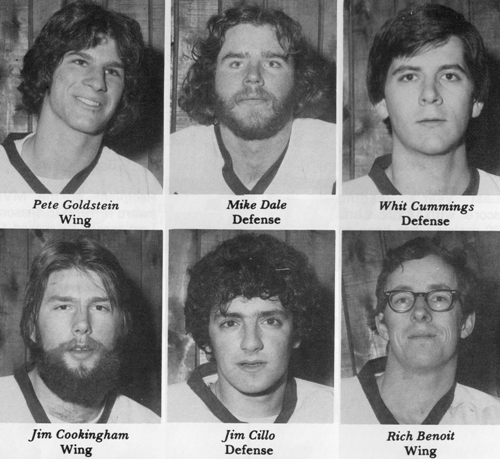
People really did have magnificent flow in the 1970s.

...well, except for Rich Benoit.

The December 14, 1976 Daily Collegian, unfortunately, only gives the events of that Sunday evening in Allentown a gloss-over treatment in the back half of an article also covering a 4-3 win at Delaware the day before the game with LU.


The Lions were involved in another close game against Lehigh but failed in a comeback bid and were defeated 7-5.

"After a strong second period we tied the score 3-3 and thought we could keep the momentum going in the third period," [head coach Bob] Hettema said. "We thought we were going to take over and skate them into the ice but instead we began to tire."

The Lions did appear to be taking the momentum away from Lehigh when Tom Horgas scored the go-ahead goal at 1:18 in the final period. But when Lehigh matched that goal a few minutes later, the partisan crowd spurred the Engineers on to victory.

Bill Richardson was in goal and stopped 42 shots. The Lion attack was balanced with Jerry Fry, Terry Brownschidle, Jim Lynch, Tom Horgas and [Bill] Galli scoring.


Lehigh, helped by the come-from-behind win, finished 11-5-0 that season, including a 6-4 win at Penn State in a rematch on January 23, 1977. In a situation mirrored by Northeast PA neighbor Scranton during its failed NCAA DIII run two decades later, the Engineers' schedule was an odd mish-mash of club teams like PSU, Delaware and West Chester, as well as varsity programs including Fairfield, Iona and Cortland State. Arguably, LU's most impressive results were 9-2 and 11-1 trouncings of RIT on February 19th and 20th, 1977. The Tigers, now an NCAA DI program of course, would go on to win national championships in 1983 (DII) and 1985 (DIII).

After 1976-1977, Penn State and Lehigh met five more times over the next few years, with the Icers finding increasing amounts of success, starting with the schools splitting a pair of meetings in 1977-1978. PSU then won at the Ice Palace on February 16, 1980, and twice more at the first two Nittany Lion Invitational Tournaments at the then-new Ice Pavilion on February 13, 1982 and January 21, 1983. The scores of those NLIT meetings were 7-4 and 12-3, a far cry from just a few years earlier when the Engineers were too steep of a hill for Penn State's puckmen.

The sudden reversal of results, unfortunately, said as much about Lehigh as it did about Penn State. By the end of the 1985-1986 season, and due to "the tension of Title IX compliance and other financial pressures [i.e., division adjustment, staffing and recruiting, league affiliation, travel and arena]," the program "faded from the athletics department’s agenda." The Icers wound up with a 4-6-1 record against LU's varsity hockey experiment.

Five years later, in 1991, the school rebooted with a club program and played one of their first games on November 3rd of that year at the Ice Pavilion against an Icers team well established as one of the giants of non-varsity hockey by that point. Predictably, Penn State cruised to a 9-1 win in what stands as the last tilt between the Icers and LU. Scott Shell had a hat trick that night, supported by two Mark Konchar goals and a 3-on-5 shorty by Brad Russell.

That Lehigh program, now unfortunately called the Mountain Hawks, has continued to develop over the last 22 years. It joined the ACHA in 1996, increased its budget several times over, and grew its association with a now-cooperative athletic department. This past season, while playing in the ACHA Division 1 ECHA - a conference that, by the way, includes Penn State Berks - LU went 15-13-1 under first-year coach Tom Laessig, the father of Ice Lions alumnus T.J. Laessig and rising Ice Lions junior forward Neil Laessig.

Although it took a couple generations, the demise and rebirth of hockey at both institutions, and several other dramatic shifts in circumstances, it appears that Penn State and Lehigh finally have a relationship worthy of their proximity and respective histories.

Thursday, September 27, 2012

Breakout Past: Varsity Debut

For this season finale of Breakout Past, I couldn't think of a better topic than the buildup to men's hockey acquiring varsity status in 1940, along with the first varsity game played by the team. Seems appropriate, right? As always for these posts, click to enlarge the articles for easier reading.

A Frustratingly Slow Process

Calls for Penn State to recognize hockey, of course, go back more than 100 years and, other than the understandable hiatus during World War I, were more or less a constant during the first four decades of the 20th century. After numerous aborted attempts at starting a team and/or constructing a rink, in late 1937, an informal team consisting largely of Sigma Pi fraternity brothers organized under coach Al Hook and played its first game against Pittsburgh on February 22, 1938, losing 4-0 at Duquesne Gardens.

While that was the only (known) game played that season, the formation of a team kicked things - including the rumor mill - into overdrive, as reported on October 11, 1938 (left side, below).


Three days later (right side, above), it was evident that the rumors were misinterpreted, as rumors so often are. Hockey was not given varsity letter status for the 1938-1939 season, although the informal team did receive $100, "which will be used to outfit this year's team." It seems likely that the funds were used to purchase the familiar (at least to history geeks) "PS" sweaters - according to the January 10th, 1939 Daily Collegian, "new uniforms for the squad have arrived. The jerseys are white with blue shoulders and sleeves."

The overdressed guy is coach Arthur F. Davis (obviously). The two kneeling in
front are Peany Gates (left) and John Dufford (right), who would combine to score
the first three goals in the history of Penn State varsity hockey.

The team went through the usual scheduling and ice availability struggles that season, eventually finishing 1-3-0 in four known games after several others (including winter break tilts with Cornell and Syracuse and the planned debut of the new jerseys against the Mountain Beach Club in Williamsport) were called off due to weather conditions. Nevertheless, Dr. Carl P. Schott, dean of the School of Physical Education and Athletics, "suggested the sport's becoming fully recognized" at a post-season banquet, as reported in the March 31, 1939 Daily Collegian. A Collegian editorial writer that December was a little more forceful in expressing himself.


As indicated, the team again received $100 for the 1939-1940 season, but still something less than "full approval," to borrow the article's choice of words.

It's impossible to ascertain that editorial's influence, but within a week, it was reported that the All-College Cabinet had formed a committee "to investigate College recognition of the ice hockey team." The All-College Cabinet, instituted in 1939 after an overhaul of student government, "functioned as the legislative branch and consisted of the presidents of each of the classes along with representatives from the Athletic Association, the Penn State Christian Association (formed by combining the campus chapters of the YMCA and YWCA), the Interfraternity Council, a new Independent Men's Council, and a few other large student organizations."

The involvement of the student-populated Athletic Association in the All-College Cabinet, and by extension the committee, is noteworthy. The students, who controlled most aspects of athletic administration in the early days of PSU sports history, eventually surrendered the "grown-up stuff" to a branch of the AA controlled by, well, grown-ups.
The alumni-dominated Athletic Advisory Committee, created during the reorganization of the Athletic Association in 1908, within a few years came to exercise nearly undisputed authority over the hiring and firing of coaches, the creation of schedules, and most other phases of athletic policy.
In 1931, the School of Physical Education and Athletics (headed by Schott from 1937 after he replaced the notable Hugo Bezdek, father of numerous rink schemes in the 1920s, among other things) took on oversight responsibility for the operation. Both students and the Athletic Advisory Committee, however, did retain power over many important matters.

Varsity Status - With A Catch

Even before the Nittany Lions finished their 3-8-0 1939-1940 campaign in the Pennsylvania Intercollegiate Hockey League, the Athletic Advisory Board reviewed a varsity application by the hockey team and, after a deliberation that possibly included consideration of the All-College Cabinet committee's conclusions, decided to support it on March 2, 1940.


The student side of the Athletic Association's vote, conducted May 13th, 1940, was not particularly contentious. However, I would like to know if any of the 35 no voters are still alive today, just so I can find him/them (AA members had to be men at the time) and say "WTF bro" to his/their face(s).


The "light vote" comment may have been in consideration of the fact that Penn State had 6,514 undergraduates in 1940 (I have no idea how many were men). As mentioned in the previous two articles, letters were also awarded to senior members of the 1939-1940 team.

Despite varsity recognition, the hockey (and ski) teams were still forced to operate somewhat informally during the 1940-1941 season. As reported in the February 13, 1941 Daily Collegian, those two teams "are still making their own schedules, planning their own trips, and handling their own financial matters." Why the awkwardness? "When the two teams applied last year for college recognition, all they asked was the College approval plus varsity letter awards...this the College okayed, also stating that the Association could not budget any money during 1940-41 for the teams, but would help them out as much as possible." "As much as possible" ended up involving an appropriation of $350, supplemented by a 25 cent admission charge to games. This money helped pay for reported $50 (on average) guarantees to opponents as well as for new equipment.

That situation was rectified before the end of that first season, when the Alumni Advisory Board pledged full support for hockey during their meeting at the Nittany Lion Inn on February 22, 1941. At that point, the AA took over all administration, and the admission charge (which had been somewhat controversial, as other varsity sports were free to students at the time) was dropped.

The First, First Varsity Game

The 1940-1947 varsity era's first game took place in Johnstown on December 6, 1940 and was a 3-1 victory over Carnegie Tech (now part of Carnegie Mellon University, of course). Here's the Collegian's write-up.


I'm not sure 20 saves on 23 shots qualifies as "brilliant hockey" on the part of the Tech goalie but hey, pumping the opponent only makes us look better, so have at it. Also, it should be about the least surprising thing ever that John Dufford scored the first two Nittany Lion goals in the history of PSU varsity hockey. He was quite good.

The puckmen also won the next three games en route to a 6-3-1 final record. It would ultimately be PSU's most successful varsity season, both in terms of winning and in terms of managing to complete scheduled matches.

Shaffer Ice Palace: Penn State's One-Time "Home"

Shaffer Ice Palace, the site of the lightly-regarded but significant occasion, is an interesting side story in and of itself. According to one account, Frank Shaffer and his Shaffer Ice Company was the area's dominant maker and distributor of ice. But when artificial refrigeration became widely used by consumers and made his business obsolete, Shaffer decided to use his expertise to build an ice rink. The precise date of construction is unknown, although it was referred to as "new" by the Collegian both before and after a February 16, 1940 game against Duquesne.

Between that game and a January 17, 1942 contest with Carnegie Tech, Penn State played eight of 16 games in that rink (two games during that span have unknown locations and could have been played at Shaffer as well). For all intents and purposes, it was PSU's primary home for a brief time.

The Ice Palace also hosted the Johnstown Blue Birds, which played the 1941-1942 season in the defunct Eastern Hockey League. The link in the previous paragraph contains a story describing how Blue Birds owner Pick Hines was inspired to locate his team in Johnstown by a packed barn for a game involving Penn State.
Early in the fall of 1941, Memorial Hospital’s Junior Auxiliary hosted a hockey game between Pitt and Penn State. Neither school had an official ice hockey team [Note: Untrue, as we've just seen]. The game between two hastily assembled squads was not hockey at its finest level.

The auxiliary had, however, sold 1,100 seats, and the Ice Palace was filled to capacity.
I'm a little skeptical of the accuracy of this for one very simple reason: the Blue Birds played their first game on November 11, 1941 and Penn State didn't even hold an organizational meeting for that season's hockey team until the next day. It's entirely possible that the game described involved Penn State students, and possibly even members of the hockey team (see: "hastily assembled" and "not hockey at its finest level"), but it's extremely unlikely that it was a game that should be counted in any recordkeeping endeavor.

The Blue Birds went broke after that one year, and "soon after the hockey season, the Ice Palace was converted for use as a manufacturing plant, and winning a war, rather than hockey games, was the priority." By the time Johnstown regained professional hockey in 1950 - in the form of the Slap Shot-famous Jets - the Cambria County War Memorial Arena had been constructed.

Thursday, September 20, 2012

Breakout Past: ACHA National Championship Pucks

1984 National Invitational Tournament
Tucson Convention Center - Tucson, AZ

March 8th: Penn State 5, Colorado 3
March 9th: Penn State 11, Marquette 3
March 10th: Penn State 7, Arizona 5

Daily Collegian coverage:
Icers fulfill goal; win national title


1990 National Invitational Tournament
Ossian C. Bird Arena - Athens, OH

Pool B
February 28th: [6] Penn State 6, [4] Arizona 5
March 1st: [6] Penn State 5, [2] Ohio 3
March 2nd: [8] Wisconsin-Whitewater 7, [6] Penn State 1

National Championship
March 3rd: [6] Penn State 4 vs. [3] Iowa State 3

Daily Collegian coverage:
Icers take NIT title with surprise wins vs. Ohio, Iowa St.


1998 ACHA National Tournament
James H. Hilton Coliseum - Ames, IA

Pool A
March 4th: [1] Penn State 10, [8] Arizona 3
March 5th: [1] Penn State 9, [5] Eastern Michigan 4
March 6th: [1] Penn State 4, [4] Iowa State 0

National Championship
March 7th: [1] Penn State 5, [2] Ohio 1

Daily Collegian coverage:
Icers melt Arizona; EMU next
Icers bury EMU; Iowa St. up next
National title on ice


2000 ACHA National Tournament
All Seasons Arena - Minot, ND

Pool B
March 1st: [2] Penn State 5, [10] Illinois 2
March 3rd: [2] Penn State 5, [7] Minot State 4 (OT)

Semifinal
March 4th: [2] Penn State 2, [3] Michigan-Dearborn 1 (OT)

National Championship
March 5th: [2] Penn State 3, [4] Eastern Michigan 2 (OT)

Daily Collegian coverage:
Icers begin road to national championship
Icers bring home ACHA championship


2001 ACHA National Tournament
Tucson Convention Center - Tucson, AZ

Pool B
March 1st: [2] Penn State 6, [10] Kent State 2
March 3rd: [2] Penn State 8, [7] Arizona 3

Semifinal
March 4th: [2] Penn State 7, [6] Illinois 3

National Championship
March 5th: [2] Penn State 7, [9] Delaware 2

Daily Collegian coverage:
Icers win championship for third time in 4 years


2002 ACHA National Tournament
The Gardens Ice House - Laurel, MD

Pool A
February 27th: [1] Penn State 2, [12] Drexel 1
March 1st: [1] Penn State 8, [8] Kent State 2

Semifinal
March 2nd: [1] Penn State 6, [5] Iowa State 2

National Championship
March 3rd: [1] Penn State 4, [7] Illinois 0

Daily Collegian coverage:
Icers best Drexel in first round
Rocky start gives Icers new urgency
Icers win 3rd title in ACHA


2003 ACHA National Tournament
Ossian C. Bird Arena - Athens, OH

Pool B
February 26th: [2] Penn State 8, [11] Eastern Michigan 3
February 28th: [2] Penn State 3, [7] Iowa State 2 (OT)

Semifinal
March 1st: [2] Penn State 5, [6] Delaware 1

National Championship
March 2nd: [2] Penn State 5, [4] Ohio 0

Daily Collegian coverage:
Icers dominate Eagles in first round
Icers beat rival Ohio for 7th national title

Thursday, August 30, 2012

Breakout Past: Thompson Spring Winter Sports Park

One of my favorite chapters of Penn State hockey history is largely an untold one - the school's near-constant attempts to construct an ice rink in the 1920s, all of which started with a lot of promise, but ultimately failed (I reviewed the first of these back in April).

Perhaps the most spectacular of these failures was the attempt to build a winter sports park at Thompson Spring, an endeavor that chewed up the class gift funds of no fewer than five PSU senior classes, from 1927 through 1931.

Where is Thompson Spring? I wondered that for quite a while myself, until finding a document from Penn State's Office of Physical Plant (PDF) with the answer:


So there you go. The white cluster of buildings just down and left from the star is PSU's waste water treatment facility. The nearby body of water on the opposite side and surrounded by dotted line (the borough of State College's boundary, apparently they didn't want to be responsible for it) is the Duck Pond, another early - perhaps the earliest, in fact - hub of skating activity in Penn State's history.

Our story begins with the Class of 1927, and their plan to establish an endowment for their class gift through New York Life to pay for a to-be-determined (as of February 22, 1927 when the following Daily Collegian article was published) item. In addition to the winter sports park, a scholarship fund and a building addition were also considered.


By September 8th of that year, things were moving along quite well. The winter sports park had been selected as the 1927 gift, and PSU (then PSC, I guess) advanced some money towards the project, on the back of repayment pledges from the classes of 1928, 1929 and 1930. The ice rink was the first phase of the project. Specifically, the plan was for two artificial pools, using dammed-off water routed from Thompson Spring. Bids were accepted for construction of the dam at that time as well.


Four months later, a contractor had been selected, and work was underway, with the optimistic forecast of a February, 1928 completion date for the rink portion of the project. The following article also provides some clarity as to how the whole thing was to be laid out.


On Valentine's Day 1928, reports continued to be optimistic. Progress had been "rapid of late" due to favorable weather conditions and included completion of "most of the excavation for the dam...and concrete is being poured." Although the prediction of skating that month wasn't going to come true, "soon" was the word used to describe when the lakes would be ready. Two weeks later though, "soon" was "April." The March 2, 1928 Collegian quotes project foreman William F. Harper as saying that "difficulties were encountered when the bed rock was found to be deeper than at first estimated and water flowed into the cut, making it necessary to pump it out."

That issue was eventually resolved, as on September 13, 1928 it was reported that the dam was complete. Additionally, the class of 1931 had by then attached its gift to the project, "which this winter will no doubt be used for skating." What really strikes me at this point is that the other aspects to the winter sports park seem to have largely become afterthoughts. In this particular article, it was mentioned that "a toboggan slide and other features attractive to winter sport lovers" are "planned." Regardless, the next month, Student Council president Harry Pfeifer still felt a need to appoint a three-student committee to develop rules and regulations for the "new Winter Sports Park," which as best as can be ascertained at this point, is just a dam and an artificial lake. Details, I suppose.

Coverage becomes sparse after the appointment of that committee, and it might not be a stretch to assume that occasional skating took place (although, as always, at the mercy of the weather without any sort of artificial cooling system). The idea that there might have been some success is bolstered by the last major discussion of the winter sports park, on December 20, 1929.


A program of hockey games? An interfraternity hockey league? Lights? Dressing booths? Student Council certainly had big plans for the place.

So what happened? With resigned frustration, I have to admit that I can't tell you, because the Collegian archives go silent on the issue after 1930. In fact, searches for "sports park," "skating rink," "ice rink" and "Thompson (or Thompson's) Spring" came up completely empty between September 29, 1930 (where it's mentioned in passing due to the way it was funded) and November 5, 1937, when the buildup to the informal hockey team that would lead to the 1940-1947 varsity team was underway. Our only real clue comes from a December 11, 1936 article, which mentions a meeting at Rec Hall that day to discuss transportation to Whipple's Dam - 12 miles away from campus - for an afternoon of skating. It seems clear that the winter sports park project was completely abandoned by then, and later articles discussing the formation of the hockey team bemoan the lack of an adequate place to skate nearby.

One thing we do know: it emphatically ended an interesting decade in Penn State hockey history, albeit one without actual hockey. There, of course, were numerous temporary surfaces attempted with little success to give the 1940s varsity team a place to practice and play, but the next try at something more permanent, the outdoor rink that, after enclosed, would eventually become the first home of the Icers, worked out pretty well.

Thursday, August 16, 2012

Breakout Past: C.J. Patrick and Concussions

The following article, about former Icers captain C.J. Patrick and his struggles with concussions, was reproduced from the March/April 1999 issue of The Penn Stater. Despite the occasional sense of foreboding one gets while reading it, the ending is a happy one: Patrick played in all 33 of PSU's games as a senior and, in addition to his typically-stout defense, had his best offensive season with 22 goals and 43 points - good for third and fourth on the team. Here's some photographic proof that he made it to the finish, in his case the handshake line after the Icers' defeat game that never took place against Iowa State for the championship of the 1999 ACHA tournament (Patrick is number 14, and apologies for the quality - if you saw the original from which I was working though, you'd be impressed).


In all, Patrick played 95 games at Penn State, scoring 37 times and adding 45 assists. As captain in his last two years, he led the Icers to back-to-back national championship games, including a win in 1998. Two other members of the legendary Patrick family tree would follow C.J. to PSU, brother Ryan - who is mentioned in the article - and cousin Curtiss. Curtiss is the son of Craig's younger brother Glenn, himself a former NHLer and the first, and still longest-serving, coach in the history of the Wilkes-Barre/Scranton Penguins. C.J. (Class of 2008) and Curtiss (Class of 2012) are both in the Penn State Hockey Hall of Fame.


Head Strong
After nine concussions, Penn State hockey player C.J. Patrick may be skating on thin ice.

by Chuck Salter
photos by Paul Fetters

The first concussion was in fourth grade. He was zigzagging down his first expert ski slope, and another skier came flying off a mogul and didn’t see the boy until it was too late. The man’s skis struck the boy in the head. The boy’s father had never been so scared, holding his bleeding and delirious son, waiting for the ski patrol to arrive.

The second one happened when the boy, just 16, was playing hockey with 18- to 21-year-olds on the Pittsburgh Penguins amateur team. “I stuck my nose a couple places where I shouldn’t have,” he says with a grin. “I weighted about a buck-thirty, and I raced this one defenseman listed 6’4”, 275 pounds, into the corner for the puck. Unfortunately, I got there first.”

The next few concussions blur together around that same time, his high school hockey days. One time a guy accidentally kneed him in the head, then it was somebody’s elbow that clocked him – routine stuff, he said – and, oh yeah, there was one cheap shot, a stick to the helmet.

“How many is that?” asks Penn State senior C.J. Patrick. He pauses, then ticks off three more concussions from playing for the Penn State Icers. “Is that nine?” he says. “That’s how many I know of. It might be more.”

No wonder Ruben Echemendia, director of the Penn State Psychological Clinic and the Icers’ team psychologist, calls him the “poster boy” for the University’s innovative sports concussion program. C.J. has single-handedly provided Echemendia with a wealth of post-concussion data, because he’s suffered more head injuries than most athletes. Last season, after his ninth concussion, C.J. asked Echemendia what he should do.

If you were my son, I’d tell you not to continue playing.

That wasn’t what C.J. wanted to hear.

He doesn’t like to think about concussion, much less revisit his own, but once he does, C.J. is matter-of-fact about the unpleasant aftereffects. He’s been so disoriented that he’s needed assistance getting off the ice and so sensitive to light that he’s squinted to see. He’s been nauseated and moody. Unable to remember something he’d just heard. Unable to walk without losing his balance. And then there were the pounding, unrelenting headaches.

And yet, he still laces up the skates, still hits the ice, still sticks his nose where he shouldn’t. Neither Echemendia nor the repeated head injuries have persuaded him to quit. Not yet, anyway.

Born into a hockey family (his father is GM of the Pittsburgh Penguins and his great-grandfather is in the Hall of Fame), C.J. learned to skate before he was 2.

Why keep playing? “I can’t imagine not playing,” C.J. says. A team captain his junior and senior years, he relishes the camaraderie, the competition, and yes, even the contact. “You know you’ve popped a guy pretty good when your teammates can hear it from the bench,” says C.J., who’s built like a fullback - 5’10”, 200 pounds, broad-shouldered - and plays center on the checking line, the Icers’ most physical line. He also has a family name to uphold. He’s a quiet leader, teammates say, and he wouldn’t tell you if you didn’t ask, but he’s practically hockey royalty. Three generations of Patricks have played in the NHL, including his father, Craig Patrick, now general manager of the Pittsburgh Penguins.

And the truth is, there’s no conclusive evidence that C.J. is jeopardizing his health by playing. He might be, he might not, and that’s good enough for him. “I suppose if I take a big hit, it could be bad, but nobody knows,” he says. “It tends to worry you a little bit. But when I get on the ice, I don’t think about it too much. If you’re scared to get hit or go near the boards, you might put yourself in a worse position and get crushed. So the best way is to be fearless.”

Much about concussions remains a mystery, and diagnosing concussions is especially difficult. On impact, the brain gyrates violently and sometimes bounces against the skull, Echemendia says. The sudden movement stretches or tears the axonal fibers that connect neurons, so that these brain cells no longer function or relay information normally. But doctors can’t see the microscopic lesions in a CT scan or an MRI, the way they can detect a broken bone or a tumor. Echemendia tracks the symptoms through a battery of neuropsychological tests, comparing an athlete’s cognitive abilities before and after a concussion. The player doesn’t resume playing until the scores return to normal and the symptoms go away.

Each brain and each head injury are different, which makes predicting the severity pure guesswork. C.J.’s next concussion could be worse, or perhaps milder. Echemendia can’t say for sure. But research suggests that someone like C.J., who’s sustained previous concussions, is more likely to get one than other players, Echemendia says. Maybe two times as likely, maybe four. However, it’s not clear whether there are cumulative or lasting effects from prior concussions; with rest, the brain seems to heal. So as far as Echemendia can tell, C.J. has fully recovered from his previous concussions. He’s lucky. In 1994, football safety Josh Kroell ’95 Lib left the team after three concussions gave him memory lapses and dizzy spells. And, a couple of years ago, the Lady Lions’ Stacey Hrivnak ’98 H&HD had to give up basketball after two concussions left her with amnesia. Her post-concussion symptoms lingered more than a year.

Ruben Echemendia, director of the
Penn State Psychological Clinic and
the Icers' team psychologist
The real danger is when someone sustains a second concussion while the brain is still repairing itself from the first one. The results can be career-ending, permanent, even fatal. “You have uncontrolled swelling of the brain,” explains Echemendia. “And the skull is finite.” The cerebral pressure becomes so great that the cells stop functioning. The person dies.

The concussion that almost ended C.J.’s hockey career were the eighth and ninth ones.

Upstairs in an office at the Penn State Ice Pavilion, Echemendia slips in a videotape labeled “C.J. Patrick’s Hits” into a VCR. Here’s C.J. racing down a loose puck at Kent State last season, his No. 14 jersey obscured by two forwards bearing down on him in the corner. You can see the collision coming, like cars in a high-speed chase. The first player knocks C.J. off his feet. The second slams him into the boards. “That’s the first concussion,” Echemendia says, watching it again in slow motion.

Cut to the next game, at the University of Findlay the next night. While fighting over the puck, a defenseman checks C.J. high into the boards. As C.J. falls backward, his helmet slips off, and the Findlay forward cross-checks him with his stick - in the head. “And that’s the second,” Echemendia says grimly.

Back at State College, C.J. knew what was coming. He calls them “the Ruben tests.” In one, Echemendia recited a grocery list, then asked C.J. to repeat it back. But he couldn’t remember more than a few items. C.J. knew he hadn’t just had his “bell rung,” the players’ dismissive description of a mild concussion. This was serious. He had frequent and severe headaches. While walking across campus, he would suddenly lose his balance and stumble. He was moody.

After two weeks, his scores returned to normal on the neuropsychological tests, but the headaches continued. “He’d be sitting at the computer and he’d have to stop reading and press a finger to his head because it hurt so much,” says Cameron Dowler, C.J.’s girlfriend and high school sweetheart. “I knew he wanted to keep playing, but I didn’t know if it was the right choice.” Neither did his mother. “I said, ‘Maybe you ought to consider hanging up the skates for the rest of the year,’” recalls Sue Patrick. “But my words fell on deaf ears.” So did those of Charles Burke, the Pittsburgh Penguins’ team physician. “He looked at me like I was nuts,” C.J. says. “He told me to quit and get on with my life.”

Not yet, thought C.J. Not after he had already sat out most of his freshman season two years earlier with a knee injury. Not now, when the Icers were 20-6 four months into his junior season, putting them into contention for the American Collegiate Hockey Association title, the national championship for schools with club hockey teams. The last year Penn State won it was 1984. [Editor’s note: It was actually 1990 at that point.]


Why keep playing? C.J.’s father knows. “If hockey gets in your blood, you can’t get it out,” says Craig Patrick, who suffered his share of concussions throughout his NHL career. After one, he had no recollection of finishing the game, or of being taken to the hospital that night.

There’s also the family connection. So many Patricks have had their names inscribed on the Stanley Cup that it could easily be mistaken for their personal family tree. C.J.’s great-grandfather, Hall-of-Famer Lester Patrick, was a hockey legend as a player, coach, general manager, and team owner in the early half of the century. Along with his brother Frank, Lester brought pro hockey to the Pacific Northwest and was instrumental in shaping the game - they introduced the penalty shot, line substitutions, and numbered jerseys. Later, Lester helped found the New York Rangers, a team that he, his son Lynn, and his grandson Craig have coached over the years. C.J. grew up following the NHL when it still had the Patrick Division, named after his family. “Maybe there’s a little pressure there,” Craig says, “but C.J.’s always been his own person.”

C.J.’s father has a photo of him holding a hockey stick before he was a year old. His mother taught him how to skate the following year. He always preferred playing hockey to watching it, often skating before and after his father’s practices. When Jaromir Jagr joined the Penguins as a teenager, C.J. and his younger brother Ryan practiced with the future superstar. A few years later, the brothers skated on the same line at Fox Chapel High School, just like the Patricks before them had in the pros. As a teenager, C.J. was in the locker room when the Penguins won back-to-back Stanley Cups. His Penn State teammates spotted the blonde-haired C.J. in a video of the championship.

C.J. still prefers playing to watching. Being benched last season, after his ninth concussion, was “the most frustrating thing I’ve ever had to go through,” he says. He couldn’t sit with the assistant coaches and watch the Icers games without flinching, as if he were on the ice dishing out punishing checks. He couldn’t walk through the stands without someone asking “When are you coming back?” (“As soon as my headaches go away,” he’d reply.) Worst of all, he couldn’t do anything to rush his recovery. He could only rest, then rest some more, and continue taking anti-inflammatory medicine and keep a log of his headaches for Echemendia. Every game, C.J. asked him the same thing: When can I play?

Three months after his concussion, C.J. was finally symptom-free. Echemendia and Penn State team physician Margot Putukian agreed that he had fully recovered, so they cleared him to play, but not before reminding him of the risks of future concussions. C.J. understood. When he returned to the ice, he wore a helmet with extra padding and a mouthpiece with extra shock absorption. A month later, at nationals, his checking line didn’t allow a goal the entire tournament. The cover of this year’s Icers program tells the rest: the jubilant Penn State players are crowded around a big, fat silver trophy, and nearly every had is pointing “No. 1!”

Will there be a tenth concussion? C.J. doesn’t expect it, so he doesn’t think about it. But Echemendia does. To avoid multiple concussions in C.J., or other athletes, he knows he must detect an initial injury, so prior to every season he reminds Penn State athletes of the symptoms and the risks, and then he implores them to confide in him or the trainer. “There are players who want to get back on the field or the ice who tend to minimize their problems,” says Echemendia. He attends the Icers’ home games to personally keep an eye on certain players, C.J. in particular. If C.J. comes off the ice hanging his head, the trainers check on him immediately: C.J., you OK? You feel all right? Between periods in a particularly physical game, Echemendia visits him in the locker room, looking for subtle signs of a concussion, anything unusual.

It’s hard to believe that anything good could come of getting hit in the head, but Icers head coach Joe Battista ’83 Bus thinks the injuries have given C.J. a deeper appreciation of the game. “When he came back last year, I’m telling you he came back with a vengeance,” Battista says. “I think he was more physical than before, and he was already a physical player. That first game, he killed off a five-on-three penalty single-handedly.”


At the end of that championship season, C.J. could have walked away from the game with dignity. But he came back to play this season - his senior year, most likely his last hockey season. Although his father tells him he has the skills to make an NHL roster someday, C.J. doesn’t think so. Besides, he figures he’ll earn more as a highly recruited management information systems major than he would as a minor-leaguer.

In the future, C.J., an ACHA Academic All-American, would rather use his head than risk injuring it. “I’m accustomed to the speed of the game at this level,” he says. “I’d be a sitting duck at the next level. I’ve seen players up there get absolutely smoked. So in that sense, I am thinking about my concussions.”

At the same time, he’s still headstrong, determined to quit the game on his terms: at the end of his senior year, after nationals, and not a day sooner. But even that seems too soon for him. I can’t imagine not playing. Yet he knows another concussion could end his career before then, this game, or the next. Will he really tell Echemendia if he gets one, even a bell-ringer?

“I haven’t been faced with it yet, so I don’t know,” C.J. says. “At the moment I get it, I’m probably going to sit down on the bench and pretend nothing’s wrong. That’s my first reaction. But when I get up to go in, I’m going to smarten up a little bit, I think.”

Echemendia hopes - and believes - that he will.