Showing posts with label History. Show all posts

Monday, October 7, 2013

Three Stars: September 30-October 6

Even PSU's Cooperall phase deserves to be remembered

3. Men's Hockey Media Day - Sights and Sounds
(GoPSUSports.com)

Much like with the women last week, I figured I could link 38 stories using the quotes given at last week's media day, or I could just give you the raw material.

PS. Is it just me, or is "sights and sounds" a really, really stupid label for something about a media day? Sights: People sitting behind a table and a microphone. Sounds: People talking. It's not a carnival.

2. Good Life: Q&A with Guy Gadowsky
(Centre Daily Times)

I've had sort of a mancrush on Guy Gadowsky ever since he revealed his music tastes to Pennsylvania Puck a while back, but I don't think I truly "got" him until recently. This interview, while good, doesn't break a ton of new ground - although this caught my attention:
We’re still very young and, obviously, competing against the programs in the Big Ten that we are, we’re not looking at expectations in terms of wins and losses. We certainly have very high expectations to continue to build on that foundation and areas that we can control.
Raise your hand if, the first time you heard him say something about laying and/or building on a foundation, you expected him to still be saying it heading into his third season at PSU. I didn't. But now, I don't really expect him to ever stop, which is something I can certainly appreciate. You could probably rephrase it as "take care of the little things and the big things (the wins and losses) take care of themselves," a line often attributed to one former Penn State coach.

1. How Penn State hockey got here
(Big Ten Network)

Finally. Someone who gets it with respect to PSU hockey history. His name is Jeremy Woo, and you can thank him by giving him a click and read.

For what it's worth, I did my part by a) linking it and b) arranging for this tribute.

Best of the Rest

Freshman goalie Eamon McAdam, during his first appearance in a full PSU uniform

A closer look at the players between the pipes for Penn State ice hockey in 2013-14
(Stack the Pads)

PennLive goalie expert Derek Meluzio gives his take on the men's crease situation, sure to be a major topic of discussion as the season gets underway.

Fans Flock To Pegula Ice Arena For Midnight Practice
(StateCollege.com)

A nice wrap up on the men's midnight practice Friday night/Saturday morning from Ben Jones, including a photo gallery.

Captain Practice A Unique Wrinkle As Season Approaches
(StateCollege.com)

Jones earned the rare double with a nice feature on how the team deals with the fact that the NCAA doesn't allow full practices until one week before most teams begin the regular season.

In move that alters landscape of college hockey, Pegula proud to unveil new era at Penn State
(Associated Press)

This one made it in more because it's an AP story that received heavy distribution than due to anything particularly fabulous about it, but I did like this quote near the end from Joe Battista:
“Someday, wouldn’t it be great to turn on the television and see Penn State play Alabama in ice hockey?”
Not if Nick Saban is allowed anywhere near that program.

PSU All-Sports Museum's Hockey Exhibit to Open Oct. 11
(GoPSUSports.com)

In last week's Three Stars, I shared a photo gallery of the new hockey exhibit at the All-Sports Museum. I thought it was open then, but apparently, it opens Friday.

Big Ten Network Makes Investment in College Hockey
(New York Times)

This one ought to get people talking:
If college hockey takes off on television, Minnesota Coach Don Lucia said he hoped two more Big Ten institutions might add the sport.

The Big Ten associate commissioner Jennifer Heppel, who oversees hockey, said she would not rule out adding associate members for hockey alone, as the conference did for Johns Hopkins in lacrosse, though not soon.

“It’s hard to predict the college landscape right now, especially Division I,” she said.
Nebraska-Omaha or UNO or Omaha or whatever they're calling themselves these days has always been tossed out as a possible Big Ten affiliate member, due to being part of the University of Nebraska system that also includes Big Ten member Nebraska-Lincoln. I suppose the same logic puts Minnesota-Duluth out there as well.

Freshman David Thompson is expected to play a big role on the Penn State blueline

Blueline depth bodes well for Penn State
(The Daily Collegian)

The Collegian is over halfway through a comprehensive and well-conceived ten-article season preview for the NCAA men. The first entry is linked above, and here are the others out so far:

B1G and Pegula will help lure recruits
Offense looks to improve with depth and experience
Potential NHL talent factor in to this season and future
Student Section looks to terrorize opposition
Penn State's nine most formidable foes
Penn State eyes underdog role with tough schedule

With the season already underway for many teams and about to be there for the rest, similar efforts are all the rage. Here are a few more...

Penn State Men’s Hockey Season Preview
(PSU ComMedia)

It really is pretty refreshing to see people finally treating the Nittany Lions like an actual hockey team and not just a... oh wow, Pegula Ice Arena is amazing, you guys. The Collegian's on board with that, as is ComRadio's Ross Insana, who checked in with his version of a men's preview.

Insana also wrote a column regarding PSU's size and physicality. We sure do have some big hombres on the squad, especially up front.

2013-2014 Big Ten Preview: Individual Awards
(Western College Hockey Blog)

WCHB - which still hasn't been re-named, despite its now-national scope - took a fairly predictable approach with respect to their guesses at Big Ten awards by largely ignoring PSU other than tossing the two recent NHL draft picks on the all-rookie team.

Penn State Season Preview
(USCHO)

Flipping over to the women, USCHO hit the Nittany Lions in their team-by-team previews and highlighted the fact that Penn State didn't really get run out of the rink by anyone in NCAA year one.
“The fact that we were there in those games, with so many close contests last year, to me was a very pay-it-forward type thing,” [Josh] Brandwene said. “We’re looking to get better defensively, we’re looking to get better offensively. We want to improve every day and build upon the opportunity we had last year to be competitive and then take it to the next level.”
Penn State Women’s Hockey: Season Preview
(Victory Bell Rings)

VBR's Mary Clarke (who did a phenomenal job tweeting the women's games over the weekend, make sure you're following her), had this to say:
Last year, Penn State surprised some people with their resilience and overall team tenacity. This year, look for the team to improve overall, with a few new additions to the forward core, a new face on the blue line, and a strong goaltending team in net. Keeping the opponent’s shots on goal to a minimum and increasing their own shots towards the net, in my opinion, will be a key to their success this season.
Also, she called me lovely, which made me feel pretty good about myself.

Blue Liner Notes: ACHA Teams Get Underway
(Black Shoe Diaries)

IcersGuy began his weekly rundown of UPark's four teams for the season with a look back at the opening series for the Women's Ice Hockey Club and the Ice Lions.

Robert Morris extends Colontino through 2016-17
(USCHO)

In an abbreviated "opponent news" section, RMU women's coach Paul Colontino received a two-year contract extension. Colontino is just beginning his third season and, in 2012, led the Colonials to the CHA playoff title.

Lofty goals for Robert Morris hockey this season
(Pittsburgh Tribune-Review)

Over on the men's side, Derek Schooley's gang will come into the season motivated by their NCAA Tournament at-large bid near-miss last season. RMU was left out of the show despite wins over Quinnipiac (the eventual tournament runners-up who spent most of the season ranked number one) and in the Three Rivers Classic title game over perennial power Miami.

Welcome, Josh Healey!
(Deadly Nuts)

Deadly Nuts recently completed a series profiling Ohio State's freshman, and it's pretty fantastic. Possibly because other people care about annoying things like "copyright infringement" (sounds like a made up thing to me), both this post and the entire blog are illustrated with MS Paint cartoons. And I've said it before, but the writing is sort of what I was/wanted to be before I lost my edge sometime in 2011 and started writing dry recaps of other people's work once a week.

I picked Healey to link because he's from that PSU recruiting hotbed of Edmonton, AB and because he played with Dylan Richard for Canada West at last year's World Junior A Challenge.

Robert Pelletier vs Conor Garland Sep 22, 2013
(YouTube)

Once in a while, something reminds me that I never deleted my "Conor Garland" Google alert. Finally, this time around, I succumbed to my morbid curiosity. So I went to look up something about him that I could use here and found... a fight video. Didn't expect that. If you're hoping to see the diminutive Garland take a Boogaard vs. Fedoruk-level beatdown (admittedly, I was) you'll be disappointed, but he eats a high enough number of quality blows for me to keep it in.

Anyway, in a partial 2012-2013 season for the QMJHL's Moncton Wildcats (26 games), Garland had six goals and 17 points for a club that went 42-23-3 but was bounced in the first round of the playoffs. So far this year, Moncton is 4-6-0 with Garland's 11 points placing him third on the team in scoring. He's eligible for the 2014 NHL Entry Draft, but at 5'7", 170 pounds opinions on where he'll go are mixed, even with his ridiculous skill level.

Sophomore Jordin Pardoski and her teammates were wound up after beating Vermont

@JordinPardoski
(Twitter)

Jordin Pardoski, reporting from the bus on the way back from the tie-win weekend in Vermont:
This maaaaaay or maaaay not be the first bus ride where NO ONE is sleeping #WoundUp

Monday, September 30, 2013

Three Stars: September 23-29


3. Women's Hockey Media Day Wrap-Up
(GoPSUSports.com)

The NCAA women's team held their media day last Thursday. Unfortunately, it was pretty lightly covered, so I didn't have the material for a roundup/link dump post.

Not that it really needs one when GoPSUSports recorded the entire thing on video and even threw in a transcript of Josh Brandwene's press conference. As someone who tries to peel back the layers of interpretation that are inevitable in journalism and give you as much raw material as possible, I approve.

2. A Salute to 32 years at the Greenberg Ice Pavilion
(StateCollege.com)

As mentioned in last week's Three Stars, Joe and Heidi Battista took the final skate at the Greenberg Ice Pavilion a little over a week ago (the facility's fate is still a bit unsettled, although it won't be an ice rink any longer).

Naturally, that meant a "Joe Battista tells stories" column for his subsequent entry on StateCollege.com. Gather 'round, children.

1. Katie Vaughan looking to backstop the Penn State women's ice hockey club to a national championship
(PennLive)

I'm sure some of you are crying bias because I gave first star to the Women's Ice Hockey Club (assuming anyone actually cares where I place the links in these posts). Of course I'm biased. We all are, it's part of the human condition. At least I'm up front with you guys about mine.

Regardless, WIHC goalie Katie Vaughan is one of the finest student-athletes Penn State has to offer and she laid down a fantastic interview here. Hopefully, we're all biased in favor of that.

Best of the Rest


@PegulaIceArena
(Twitter)

Penn State held an open house at Pegula Ice Arena on Saturday which, as it turned out, doubled as a reunion of NHL alumni. Above, obviously, is Mario Lemieux, pictured with Heidi Battista.

Former Red Wing/Whaler/Hurricane/Flyer Keith Primeau was also there, and while he might not be in the "greatest ever" discussion, he did once do this.

Szyszko Retains Captaincy, Rothman and Schaffer Named 2013-14 Alternates
(psuwihc.com)

UPark's ACHA teams named their 2013-2014 letter-wearers last week. As should be fairly obvious from the header, Carly Szyszko will once again wear the C for the women, while Allie Rothman and Ashton Schaffer take the As.

The Ice Lions also have some highly-worthy leadership: Max O'Malley is the captain, with Creek Lewis and Ryan Urban serving as alternates.

Ice Chips Blog - Season previews for 2013-14
(achahockey.org)

Both of those teams were picked to return to nationals this season on the ACHA website.

Ohio State hockey: B1G dreams beckon
(Land-Grant Holy Grant)

Here's a well-done preview of the Ohio State men's team from OSU's SB Nation blog...

...I'm a little worried though. To this point, the people who support and write about Buckeye hockey appear to be very nice, reasonable and articulate. In other words, the polar opposite of their neanderthal football brethren. So basically, what are they up to?

Tougher schedule would help MU women's hockey
(GoErie.com)

Over in Erie, people are fretting because they don't view Mercyhurst's schedule as tough enough to prepare the Lakers for their annual NCAA Tournament trip.
But after [the Minnesota State, Ohio State, Cornell, Clarkson, Robert Morris and St. Lawrence] games, which teams on the 33-game schedule will give the Lakers the battles they need to prepare for the postseason?

Syracuse? The Orange are winless in 23 career meetings with the Lakers. The rest of the CHA? Lindenwood, Penn State and Rochester Institute of Technology finished last season with a combined 30-68-10 record. Lindenwood begins only its third year in NCAA Division I. Penn State and RIT joined D-I last year.
I guess I should probably be mildly offended, but I'm not. We're a second-year NCAA program. We'll get there.

RMU women’s hockey team seeks to climb conference
(City of Champions)

A nice preview of the perenially-tough RMU Colonials who, with all due respect to a growing Syracuse program, have emerged as Mercyhurst's primary College Hockey America threat most of the time.

Women's hockey drops 2013-14 regular season opener to No. 3 Clarkson
(RITathletics.com)

Five regular season games have already been played by CHA teams. Lindenwood lost to and tied with Bemidji State over the weekend, while Mercyhurst split that aforementioned Minnesota State series. Then there's this one, a 12-1 win by third-ranked Clarkson over RIT. Yikes.

New Community/UNO Athletic Facility
(YouTube)

The first time one of my favorite teams won a championship, I really enjoyed the offseason. Got the t-shirt, got the hat, went to the parade, basked in the glow. It was glorious. Then, just before the next season started, I realized something obvious but generally forgotten in brief moments of euphoria: they don't cancel the league so that my team can be the champs forever. You still have to go out and defend the title, and you probably won't do it successfully.

That's sort of how I feel about Pegula Ice Arena right now. Other schools aren't going to stop building new arenas just because we have one. And much like PSU people feel PIA is better than new facilities at Notre Dame, Miami and Minnesota-Duluth, others will feel that their place beats ours.

One of the early challengers will likely come from UNO, and while it looks fantastic, it's going to double as a basketball arena. So I think we'll be okay up against that one.


Penn State All-Sports Museum
(Facebook)

Hockey exhibit at the all-sports museum? Hockey exhibit at the all-sports museum.

You know, it's interesting... the more I learn - the outstanding collection of memorabilia shown above being the latest bit of knowledge - the more I'm convinced that my issues with the handling of Icers and Lady Icers history are not due to an institutional flaw, but instead are a result of stubborn and/or lazy individual(s).

Basically, I'm not sure what exactly USA Hockey teaches in the course of its prestigious Brian Fishman Internship, but I'm not impressed.

Thursday, September 5, 2013

Breakout Past: Shaffer Ice Palace

Last September, in the build-up to Penn State's first modern varsity games, Breakout Past examined the last first varsity game for PSU hockey, a 3-1 win over Carnegie Tech on December 6, 1940. The venue for that contest was the Shaffer Ice Palace in Johnstown.

With Penn State now about to move into Pegula Ice Arena, it's probably as good of a time as ever to take one more look back at that "home" rink.

Ad in the December 12, 1939 Altoona Mirror

The history of Shaffer Ice Palace was outlined in last year's post, but just to review: Frank M. Shaffer owned Johnstown's pre-eminent ice-making business in the early decades of the 20th century. By the late 1930s, however, artificial refrigeration had made Shaffer's outfit obsolete. So he decided to combine his facility at the end of McMillen Street with his knowledge of ice and open a rink.

Following its December, 1939 initiation, Shaffer was home to numerous events including hockey, ice shows and even boxing. In the 1941-1942 season, it gained a primary tenant in the form of the Johnstown Blue Birds of the old Eastern Hockey League. And of course, there were the Nittany Lions who, between February 6, 1940 and January 17, 1942, played at least eight of their 16 total games there, going 5-3-0 in those matches.

Shaffer Ice Palace interior. Photo: Vintage Johnstown

The Blue Birds, although successful on the ice, going 34-20-6 and tying for first in the standings, were a disaster off of it. Owner Bill "Pick" Hines had made the money to buy the team on a horse racing bet and his lack of true wealth, combined with poor attendance, came to a head almost immediately. Throughout the year, Hines was unable to make payroll and required outside cash infusions to help get the Blue Birds get through. The unstable team met its end shortly after its sole campaign when the Ice Palace was converted for manufacturing purposes supporting the U.S. effort in World War II, which began in the middle of the season with the attack on Pearl Harbor.

While it would be a stretch to call the demise of Shaffer a major factor in Penn State's varsity team eventually sharing the same fate, the loss of an available central PA sheet certainly didn't help. PSU would only play 11 more varsity games after that 1941-1942 season and, largely thanks to WWII gas rationing, only one at the Hershey Sports Arena, the other most frequent venue from those days. The reasons hockey didn't work out at that time are many and varied, but most trace back to the war in one way or another, whether it be the need for able-bodied young men overseas, materials restrictions that hampered plans for an on-campus facility, or, obviously, the choking off of the team's existing rinks in one way or another. Since college programs across the nation faced similar issues, with many suspending their teams for the duration, further complexity was added to the already-difficult scheduling process.

Duquesne Gardens in Pittsburgh is long gone. So is the original Ice Pavilion and the Mechanicsburg Skatium, PSU's temporary outpost after the Icers' first rink was re-purposed as a later-demolished field house in 1978. There are no longer tennis courts to flood across Curtin Road from West Halls, the Thompson Spring Winter Sports Park was abandoned and Beaver Field, both New and Old, gave way to development decades ago. Setting Pegula Ice Arena aside for a moment since it hasn't hosted a game yet, the only remaining structures that could have been considered a home (or potential home) for Penn State hockey are the "new" Ice Pavilion, what is now called Hersheypark Arena...

...and the Shaffer Ice Palace.

Yep, somehow, in an era that produced and then discarded ice rinks at a staggering rate (another example: Huntington, WV's Iceland Arena, which also hosted a PSU game during the original varsity era), the site of what will always be the Nittany Lions' first varsity game is still there.

It's neighborhood has deteriorated significantly since 1940, as what was once a sturdy working-class area has been largely abandoned and left for dead by relocated industry. But two functioning businesses do bookend the building. One is Jack Brown Wholesale, which actually uses the place to help sell siding, shingles and other things that would be useful to the surrounding residences.


Then, after following a side that runs along an alley called Bell Place...


...on the opposite end is the salvage yard for Brat Towing & Recovery, Inc. Unfortunately, Brat's fence prevents a better view, but I suspect that this is closer to what the building looked like 70-plus years ago.


In the postwar years, 1950 to be exact, Johnstown would become home to the Cambria County War Memorial Arena. Upon its completion, the EHL returned in the form of the Johnstown Jets. That team would last until 1977 and deliver the inspiration for Slap Shot, a film shot in town (including at the War Memorial), giving Flood City a healthy degree of hockey celebrity status. Since the Jets, the arena has hosted the ECHL's Johnstown Chiefs - a team whose alumni include Icers Mark Scally, Justin Depretis, Bill Downey and Curtiss Patrick - from 1987-2010 and, beginning last season, the NAHL's Johnstown Tomahawks.


While Penn State's history at the War Memorial isn't extensive beyond the Icers-to-Chiefs connections, it's worth mentioning nevertheless. The 1983-1984 national championship team played there six times, including twice each against Alabama-Huntsville and Notre Dame (both of which are now in NCAA Division I), as well as against Arizona.

Tuesday, August 20, 2013

Former Club Sports Chief McCullough Passes

Vance McCullough, Penn State's director of club sports from 1978 until 1997, a pillar of the Icers family, and a charter inductee into the PSU Hockey Hall of Fame upon its 1991 establishment, passed away on Monday according to Joe Battista.


McCullough was a driving force in creating a club sports department supporting many programs that were organizationally on par with NCAA teams, but for the recognition and the existence of scholarships. His legacy included not only the Icers and later the Lady Icers, but continues today through the success of the Ice Lions and Women's Ice Hockey Club, as well as Penn State's nationally-recognized men's and women's rugby teams. Penn State's club teams for field hockey, men’s lacrosse, women’s rugby, baseball, men’s track and field, and women’s cross-country all won national championships during the 2012-2013 academic year.

Although involved in non-varsity sports, McCullough profoundly affected three current PSU varsity teams. His 1987 hiring of Battista to coach the Icers and its eventual impact on men's and women's hockey needs no explanation. Additionally, he was responsible for bringing on Pat Farmer, who led Penn State's women's soccer team for its first seven seasons after it elevated to varsity status in 1994. In 1998, the Nittany Lions won a first Big Ten title - and they've won every one since as well, 15 in all.

The following biography is adapted from the 1996-1997 Icers program:


McCullough first came to Penn State in 1961 as an undergraduate. He received a bachelor of science degree in physical education teaching and coaching and a U.S. Army commission in the infantry. He then commanded an advisor team in the central highlands in Vietnam in 1968 and 1969 before leaving the Army in 1970 as a captain and returning to Penn State.

During the next few years, he earned a master's degree in sports psychology, was an instructor in the required physical education program and an assistant director of intramural sports. In 1978, McCullough became the director of club sports. He was involved in a wide range of recreational and non-varsity activities and was both an advisor and facilitator to recreational groups. For competitive teams, like the Icers, he provided administrative insight, direction and support.

McCullough has said that back in the old days, he drove teams, advised people, substituted as a coach at times, worked in concession stands, raised funds and helped put the program together, overseeing many of the activities that later became the responsibilities of Hockey Management Association. McCullough was an avid fly fisherman and taught a well-known and popular course in the sport at PSU.

He was married to Ruth Hussey, a long-time academic advisor to the Icers. The couple had five children, all of whom graduated from Penn State.

"I've certainly enjoyed working with the large club sports program," McCullough said near the end of his time as director. "With [many] teams and clubs, it is always important to acknowledge the tremendous contribution of the volunteers who are dedicated to their own specific activities and devote a lot of time, effort and funding to support these activities. It is those people who made what may look like an impossible task possible to do."


Former Icers and Nittany Lions broadcaster Steve Penstone marked the tragic news by posting a video of a 2010 interview he conducted, in which McCullough reminisces about his time as club sports director and his efforts to grow the Icers program beginning with a period when the team had no rink, quite the contrast to where we are today.


Wednesday, August 14, 2013

Breakout Past: Team of Destiny

Joe Battista with 2001 seniors (left to right) Greg Held, Alon Eizenman and Mike Blevins

The 2000-2001 Icers could probably be considered the peak of PSU's early-2000s ACHA dynasty. By that season, winning had become more coldly efficient than stunning (as it had been the year before). It was also the only intersection between one of the greatest players in ACHA history, Alon Eizenman, and a couple other holdovers from the 1998 Murdoch Cup winners with guys like then-freshmen Glenn Zuck and Curtiss Patrick, junior Neal Price and a sophomore class that would go on to win titles in each of its four collegiate seasons.

Predictably, Penn State steamrolled its way to a 24-4-2 regular season, losing only to CIS school York on the road, in overtime at Ohio, and a December Ice Pavilion sweep at the hands of Eastern Michigan by a pair of 4-3 scores. The Icers won both in-season tournaments on the schedule, the Two Nations Cup over CCAA programs Seneca and Carleton, and the Nittany Lion Invitational by a combined 17-0 blowout of Navy and West Chester.

The national tournament that year was hosted by Arizona. PSU entered as the second seed (predictably, behind EMU) and cruised through Pool B by beating Kent State 6-2 and the host Icecats 8-3. However, the Icers were the only team in the top four to advance to the semifinals as Illinois trumped No. 3 Minot State, Iowa State took down No. 4 Ohio and, most shockingly of all, the Josh Brandwene-coached Delaware Blue Hens beat top-ranked EMU 6-5 on the first day of the championships and went on to win the group. With the other favorites out of the picture, Penn State made short work of Illinois (7-3) and Delaware (7-2) to take the crown for the second time in a row and the third time in four years. Sure it was aided by the upsets, but nothing closer than four at nationals? That's pretty dominant.

Former Johnstown Chief Bill Downey is among the 2000-2001 Icers still involved with hockey

By ACHA standards, a ton of players from that team went on the play professionally, including Zuck, forward Bill Downey, defenseman Josh Mandel and goaltenders Scott Graham and Brian Gratz. Eizenman and Patrick were particularly noteworthy in that regard, with the former playing in Israel and France (and internationally with the Israeli team) for six years and Patrick (of the Patricks, for those unfamiliar) enjoyed a five-year career primarily in the ECHL but also including 11 games and two assists in the AHL.

That was then. What about now? Beyond the investment brokers, lawyers, doctors and web developers in the group (and there are plenty of people that have done very well in a wide range of fields), what of those still involved with hockey?

Click to enlarge

Head Coach Joe Battista (front row, center): Associate Athletic Director for Ice Arena and Hockey Development, Penn State

Assistant Coach Dave Bauer (middle row, fifth from left): Head Instructor, Bauer Hockey Training Center

Assistant Coach Darren Hersh (middle row, third from left): Goaltending Coach, Reading Royals (ECHL), also Instructor, Goalie Academy

Bill Downey (back row, sixth from left): Director of Operations, Penn State Men's Hockey

Ryan Patrick (middle row, sixth from left): Hockey Director, Pegula Ice Arena

Geoff Beauparlant (front row, second from right): Head Coach, Kenai River Brown Bears (NAHL)

Joe Sheridan (back row, fifth from left): Assistant GM, Wells Fargo Center

Brian Gratz (front row, far right): Head Coach, Bloomington Thunder (SPHL)

Thursday, June 13, 2013

Breakout Past: Battista Scouts The Cyclones

At the conclusion of a 19-6-3 1989-1990 regular season, Joe Battista's third as Icers coach, Penn State entered the 1990 National Invitational Tournament in Athens, OH as an uncharacteristically heavy underdog. PSU was the sixth seed (of eight), and also faced a pool including host Ohio, a 24-1-0 team that hadn't lost at home in three years. No big deal. John Gray's 49 saves included a shutout of the Bobcats over the final 40 minutes and John Ioia's power play goal was the winner in a 5-3 victory on March 1, 1990, following a 6-5 win over Arizona in the tournament's opener.

Beating OU clinched first place in the Icers' four-team group and a berth in the championship game, so PSU mailed it in the next day and lost 7-1 to Wisconsin-Whitewater. It wasn't time off for Battista though, as he scouted an Iowa State-North Dakota State game in the opposite group that determined the other participant in March 3rd's final. Via Special Collections at the Penn State University Libraries, here are the notes he took during the game. Click to enlarge.


One thing seems pretty clear: Battista viewed ISU as a spent team. Before the first intermission, he observed that they "slowed considerably in [the] 2nd half of [the] period. In the latter stages of the second period, he wrote "both teams appear very tired," and by the beginning of the third period, he believed that NDSU "has more left," that the Cyclones' "goalie is tired" and that one of Iowa State's forward lines is "out of gas."

A lot of that may have had to do with how ISU coach Al Murdoch had the team playing. Other notes on his team pointed out their aggressive forecheck, quick transitions, and individualistic tendencies, along with the fact that the game at hand was played with a lot of pace, requiring quick changes. Battista didn't seem to be a fan of the Cyclones' blueliners, classified as big and slow, fond of taking chances, and able to be beat with speed, as happened on a late first-period goal by the Bison. Towards the end of the game, and spanning the columns for both teams, Battista wrote that PSU's opponent "will subconsciously lighten up knowing OU is out."

So... what to do with all of that knowledge? Easy. Apply it to your last-minute coaching before Penn State battled the Cyclones for the national championship.


It's simple to find where Battista incorporated his ISU-NDSU observations:
  • "Subconsciously they may let down after their win over NDSU. Also because they're not playing OU."
  • "Will they have enough left after yesterday? Third game in three days for their goalie - tired!"
  • "Change quickly, keep them off balance."
And here's one for fans of the Miracle on Ice:
  • "This is our 'Finland' game. We already beat the Russians now we have to finish what we came to do!"
At the very top of the page, Battista reminds himself to get a letter from "Paul," meaning former Icers faculty advisor Dr. Paul Cohen. Here is that letter.


The legwork ultimately proved successful, of course, as Andy McLaughlin scored with just over three minutes remaining to boost Penn State over the Cyclones 4-3. Midge Hutchison, Chris Cervellero and Jim Adams also scored, while Gray made another 35 stops. Afterwards, what PSU's head coach told The Daily Collegian should be obvious to anyone who has read this far.
"Iowa State was a better hockey team on paper," Battista said. "We knew they were tired though from their Friday night game against North Dakota State."
I'd argue that, in fact, Penn State was the better hockey team on paper, provided that the paper comes from a standard-issue legal pad.

Wednesday, June 5, 2013

Breakout Past: Penn State vs. Georgetown, 1/24/1942


Today's starting point, quite obviously: a pass for Penn State's January 24, 1942 game against Georgetown, a part of Penn State University Libraries' Special Collections, just to get the credit in right at the top.

It's not really a "ticket," per se, based on the fine print. This document was to be exchanged, along with fees and taxes, for a ticket at the box office at Riverside Stadium in Washington, DC. It was issued by Riverside's advertising department, so it's probably fair to call it a promotional effort - hand out a bunch of passes to get people in the door, then hope they all buy peanuts.

To support that view, the pass also included an attached note.


Unfortunately, a search for more on Joseph E. Rice was fruitless (he may have attended PSU circa 1919, but that's unconfirmed), but the generic greeting and stated goal gives off the impression that Rice flooded the Penn State community in DC with passes and hoped a few would show at the game.

The Daily Collegian offered unusually robust coverage of this one, as judged against the standards of the time, including a preview story on game day:


Handicapped by thawing weather conditions which have kept them idle for the past week, the Lion stickmen will seek to upset a favored Georgetown University squad tonight in Riverside Arena, Washington, DC.

Undefeated, untied Georgetown boasts a veteran lineup which has averaged the astounding record of eight goals per game in [four] victories this season. Last week, they humbled a strong University of Pennsylvania team, 4-1.

Tonight's lineup will again have Captain Larry Lightbody guarding the nets, and Bert Anthony and Tom Goodwin at the defenses. Mike Fedock and Earl Johnson will fill the wing spots, and Johnny Dufford will be at the center position.


As both the Collegian and the pass note, the game was contested at a facility called Riverside Stadium, situated along the Potomac in the northwest quadrant of Washington. Constructed in 1938 and 1939 as the United States recovered from the Great Depression, Riverside was a massive complex that hosted all manner of sport in its time. The main arena seated approximately 6,500 for basketball (roughly 1,500 fewer for hockey) was briefly home to the cagers from both Georgetown and George Washington Universities in the early 1940s, as well as a professional hoops team in the American Basketball League called the Washington Heurich Brewers, after a neighboring brewery. An adjacent football field hosted the DC public schools' football championship, and boxing and roller skating were also big draws at Riverside. And of course, there were frozen-water events like the Ice Follies, the Washington Eagles of the old Eastern Hockey League, and Georgetown's team, which began play in the 1938-1939 season before gaining university support the following year.

Riverside Stadium's heyday was remarkably short-lived - only about four years or so - thanks largely to competition from the cross-town Uline Arena, which opened in 1941. Uline, among other things, hired away Riverside's arena manager, then brought in an American Hockey League team (the Washington Lions) that helped force the Eagles out of business in 1942. Uline, which became the site of the first U.S. concert by The Beatles in 1964, stole college hockey as well, as both of the Nittany Lions' contests in the national capital following 1942 took place there. By late 1951, when the federal government sued to take over Riverside to house the then-new CIA, it was used exclusively as a roller rink. The CIA departed for Langley, VA in 1961, and both Riverside and the Heurich Brewery were razed to make way for the John F. Kennedy Center for the Performing Arts, the Watergate complex and the jumble of freeway ramps that surrounds the area.

Before discussing the specifics of the match, I need to let you know that the three accounts I have - the Collegian, the Washington Post and the Washington Star - differ from each other in many respects. Lineups, times of the goals, identities of those with assists and penalties, and even the sequence of the goals (according to the Post, PSU tied the game at one before GU went ahead 2-1, while the other two say the Hoyas were up 2-0 at one point) are inconsistently reported. All three agree on the goal scorers, but that's about it. Rather than give you three different versions of the same events, I've tried to identify the most likely truth on a case-by-case basis, usually helped by consistency between two of the three write-ups, but admittedly sometimes based on gut instinct.

Georgetown's Bill Deegan (center) paced the Hoyas' attack

Anyway, the game itself, at least from the Penn State perspective, mirrored Riverside Stadium's life in that a promising start against the powerful Hoyas fell apart quickly and definitively in the late going. While Georgetown jumped out to a 2-0 first-period lead thanks to goals from Bill Deegan and John Cassidy, PSU battled back through Ted Cauffman and Earl Johnson to level the game headed into the third period.

Then Deegan took over.

The senior, who (according to the Post) was set to join the Marine Corps after graduation - remember, Pearl Harbor was less than two months before this game - ripped off a natural hat trick in the third period, giving him four goals in all and putting the game out of the Lions' reach. In the days before the late-1950s Montreal Canadiens inspired the now-taken-for-granted rule that ends minor penalties after a power play goal, Georgetown scored four times with the man advantage according to the Collegian, despite the fact that PSU only took three penalties all game long (given the times of the goals, it seems likely that the first four Hoya scores, possibly occurring during just two different PSU penalties, were the ones referenced). John Dufford pulled a late goal back from Johnson's assist, but it only served as window dressing.

Here's an attempt at a box score - once again, sort of a composite of three varying accounts.

Lineups
Penn State
Goal: Lightbody; Left Defense: Anthony; Right Defense: Goodwin; Center: Dufford; Right Wing: Johnson; Left Wing: Fedock; Spares: Steva, Cauffman, Templin, Burford, Fisher, Hill, Heberling, Sussman.
Georgetown
Goal: O'Neill; Left Defense: Perpich; Right Defense: Yukna; Center: Deegan; Right Wing: Cassidy; Left Wing: McQueeney; Spares: Conway, Routh, Werder, B. Burnet, J. Burnet, Pander, Fullam.
First Period
Scoring
1. Georgetown, Deegan (J. Burnet), 7:45; 2. Georgetown, Cassidy (Pender), 8:15; 3. Penn State, Cauffman (Dufford), 10:45.
Penalties
1. Penn State, Johnson (tripping); 2. Georgetown, Perpich (tripping).
Second Period
Scoring
4. Penn State, Johnson (Fedock), 15:02.
Penalties
3. Penn State, Johnson (tripping).
Third Period
Scoring
5. Georgetown, Deegan (Pender), 7:10; 6. Georgetown, Deegan (Cassidy), 8:10; 7. Georgetown, Deegan (Cassidy), 17:50; 8. Penn State, Dufford (Johnson), 18:30.
Penalties
4. Penn State, Fisher (tripping); 5. Georgetown, Conway (interference).

"The Best College Hockey Game of the Season," as hyped by the pass? Maybe not, but regardless, the defeated Penn State squad garnered respect. According to the January 28, 1942 Collegian, "the Lions were adjudged 'the strongest visiting collegiate team' to play in Washington's Riverside Stadium thus far this season."

This Washington Star photo of the game was captioned: "Goalie Larry Lightbody of Penn State took this shot by John Conway (6) of Georgetown on his cranium in order to save a point. It was useless pain as the Hoyas carried off the laurels, 5 to 3, at Riverside last night.

Mr. Rice, by the way, was extremely successful in his attempt at getting a good crowd to the game. Attendance figures given ranged from "more than 4,000" (Star) to 4,600 (Collegian), with the latter account stating that 1,000 Penn State alumni were there. Six weeks after the game, the Post (which revised its initial count of 4,200 to 4,600 by that point) called the throng the largest ever recorded for a hockey game at Riverside Stadium and, in previewing PSU's return to DC to face the Navy All-Stars on March 10th of that season, said that Penn State "has established itself as far and away the best collegiate box office attraction to ever appear on local ice." Toss in the fact that Georgetown's band was at the game, and it's probably not a stretch to call the affair one of the great atmospheres in Penn State hockey history, even today.

Georgetown improved to 5-0-0 with the win, while the loss dropped the Nittany Lions to 1-2-0, although Art Davis' charges would go on to win four of their final five games to finish 5-3-0. Perhaps the commencement of U.S. involvement in World War II made it predictable, perhaps not, but following the season, the 1940-47 varsity era included just nine more official games, with only two of those ending in wins.

Friday, May 17, 2013

Breakout Past: Who Wants to Marry an Icer?


On February 15, 2000, over two hours in Las Vegas and in front of 22 million viewers on Fox, Californian Darva Conger won a beauty pageant-style competition against representatives from the other 49 states for the right to marry Rick Rockwell. Rockwell, then 42 years old, was vaguely hyped by the network as a very wealthy man, although little was known about his background or what, exactly, made him wealthy. The victorious Conger also received $100,000 in prizes, including a $35,000 engagement ring.

The television special, called "Who Wants to Marry a Multi-Millionaire?" and immediate viewership success aside, was almost universally panned. One side of the political spectrum mourned for family values, while the other fixated on the show's exploitation of women. Just about everyone expressed concern for the direction of society in some form or another.
The show was an equal-opportunity offender: Everyone from the left-leaning National Organization for Women to L. Brent Bozell's right-wing Media Research Center was disgusted. "It took something like this to make the Miss America Pageant look good to me," says NOW president Patricia Ireland.
"Multi-Millionaire's" legacy today is crystallized in "worst ever" lists. In 2010, Entertainment Weekly named it the fourth-worst reality show ever and TV Guide has called it the 25th-worst show of all time.

The marriage between Rockwell and Conger, predictably, was annulled less than two months later and not very amicably. Conger, in particular, hit the talk show circuit after the fact to make clear to as many people as possible that the program was contrary to her morals, that she never had sex with Rockwell and that the entire thing was more or less a completely horrible experience for her. Shortly after, she posed for Playboy and beat up Olympic gymnast Olga Korbut on Celebrity Boxing (1, 2, 3), the latter payday giving Conger the rare distinction of appearing on two different shows from the TV Guide list. Today, Conger is back in relative obscurity, save for the occasional "where are they now?" article, as a Northern California nurse.

Rockwell did not escape the sometimes punishing glare of the spotlight unscathed. The most damaging item that came from the inevitable prying into his background was the discovery of a restraining order filed in 1991 by Debbie Goyne, a former fiancee of Rockwell's, who alleged abuse (the restraining order becoming public torpedoed re-airings of the show, along with planned follow-ups and spin-offs).

His finances were also called into question. Rockwell, in the 20 years prior to "Who Wants to Marry a Multi-Millionaire?," worked as a stand-up comic notable for outlandish attempts at publicity, a motivational speaker and a movie writer and actor who dabbled in real estate. People who are very successful at those things are generally multi-millionaires, but Rockwell's high points in Hollywood were a significant-but-only-for-our-purposes (and uncredited) turn as Steve Christoff in the 1981 TV movie Miracle on Ice and works of art like this:


The public was generally satisfied by Fox's claim in response to the criticism that Rockwell had a net worth of just over $2 million (with $750,000 of it liquid), barely meeting the "multi-millionaire" threshold, but still well short of the hype leading up to the show. Over the last 13 years, he's more or less dropped out of showbusiness and has worked as a flight instructor in San Diego. In perhaps the ultimate display of just how fleeting those 15 minutes can be, he has just 42 followers on his Twitter account.

One detail about Rockwell's background that remained relatively unknown throughout the episode: he played for the Icers.

Rockwell, whose birth name was Richard Balkey, is a Pittsburgh native and a Fox Chapel Area High School alumnus who graduated from Penn State with a health and fitness degree in 1979.
Even then, Mark Horgas, who played ice hockey with him [at PSU], noticed his former teammate's desire for the spotlight. Like the time the team was at a hotel near Philadelphia and Rockwell went onto the empty stage in the lounge to regale guests with his comedy.

"He had this joke routine pretending to be Jackie Stewart, who was this race car driver, and this safecracker routine, you know, making a noise like the dial spinning. That was just Rick," Horgas said.
Balkey in the 1979 La Vie
Balkey gave other indications of his future while an undergrad. As a Sigma Pi brother in 1978, he won the fraternity division of the Phi Psi 500 (a former PSU tradition popular during the 1970s and 1980s that involved people racing to drink in several bars, often in crazy costumes, and raising money for various charities - here's some video taken from 1982's version). The previous year, he put on a hideous bikini to help Sigma Pi win first place in a 1930s bathing beauty contest generating more than $500 for Sight Conservation and Aid to the Blind.

His two-year career (1976-1978) as a checking left wing for the Icers was really only notable due to events 20-plus years after the fact, but a couple of highlights occurring one week apart are worth mentioning. He scored the eventual game-winning goal in a 4-2 Mid-Atlantic Collegiate Hockey Conference semifinal victory against Villanova (then the Icers' biggest rival) on March 12, 1977. In a three-game spring break series against the University of New Brunswick March 3-5, 1977 treated as a tune-up for the conference tournament, Balkey tallied four times and added an assist in a Penn State sweep. In all, the Icers went 29-14-5 with Balkey on the roster, winning a pair of MACHC regular season titles.

Someday, millions will undoubtedly watch a Penn State hockey alumnus participate in the Stanley Cup playoffs. But even once that happens, it will take an awful lot to top the television splash made by Rick Rockwell.

Thursday, April 25, 2013

Breakout Past: Penn State vs. Lehigh - 12/12/1976


Somewhat surprisingly, given its location in Bethlehem, PA and its long history playing hockey, Lehigh University doesn't really have much overlap with Penn State through the decades, just 16 games in all.

The teams met twice, in 1939 and 1940, during the era when the so-called "informal team" that would eventually lead to PSU's first varsity attempt represented the university (the latter of these two meetings was actually a conference game, in the Pennsylvania Intercollegiate Hockey League that only lasted one season). After the Nittany Lions gained official recognition, two more games followed, in 1941 and 1942. Each of these first four contests was played at the famous HersheyPark Arena (then called Hershey Sports Arena) and each was won by Penn State.

After that though, the two programs diverged. A confluence of circumstances, many derived from World War II in one way or another, killed PSU's program in 1947, and hockey was dormant at the school until the birth of the Icers in 1971. Lehigh, while undoubtedly running into similar hardships, still managed to establish a university-recognized hockey program playing in the ECAC's Division II by the late 1960s (the ECAC's divisional system predates and sometimes conflicts with the NCAA system), later shifting to Division III.

LU hockey helped launch the careers of a pair of noted coaching careers. One, Don "Toot" Cahoon, had long tenures at both Princeton (1991-2000) and Massachusetts (2000-2012). Cahoon, who is the only person not named Guy Gadowsky to lead Princeton to the NCAA Tournament, coached Lehigh to a 10-5-2 record in 1973-1974.

Bill Riley Jr., best known for his 22 years (1969-1991), three NCAA Division II national championships and a subsequent, successful transition to Division I at the school now known as UMass-Lowell, got his start with the Engineers in 1968-1969 after graduating from Boston University. Riley is part of a legendary coaching family that includes uncle Jack, who led the 1960 gold medal-winning U.S. Olympic team and was the bench boss at Army from 1950-1986. Jack's sons Rob (1986-2004) and Brian (2004-present) have coached the Black Knights' since Jack's retirement, filling out what has to be the longest single-family coaching dynasty in sports history.

The Engineers - Lehigh's current nickname, Mountain Hawks, didn't come along until 1995 and is vastly inferior anyway - played at the Ice Palace in Allentown, a venerable rink that opened in 1924, but closed in 2004 due to competition from newer facilities in the area. Now residing at the Ice Palace's address of 623 Hanover Avenue: The Palace Banquet and Conference Center, named after the rink. This photo is from 1992, but I suspect the place looked pretty similar to this throughout the 1970s and 1980s:


Apologies for the watermark. I attempted to hand The Morning Call money in exchange for a clean copy, but kept getting a 404 Page Not Found error when clicking on "buy." This is why you're dying, newspapers.

Penn State began scheduling Lehigh once again as early as the Icers' second season, and as one might expect with games between a nascent club team and a varsity program, the results favored the Engineers to the tune of an 0-3-1 record for PSU from 1972-1974 - although the Icers did manage the tie and an overtime loss at the original Ice Pavilion during Cahoon's season in Bethlehem.

After LU fell back off the schedule during Morris Kurtz's tenure (1974-1976), they returned for a game at the Ice Palace on December 12, 1976 - and a surviving program for the contest making its way into my hands more than 36 years later is the impetus for this post. The cover obviously led things off, so here's PSU's lineup card from the middle of publication (click to enlarge):


That more or less does it for the Icers portion of the booklet, although Lehigh's lineup on the opposite page refers to the Engineers' games with Penn State, among others, as "tune-ups for a crucial weekend series at Cortland State on Feb. 4 & 5." Ouch.

The program, as is often the case, functions largely as a vehicle for advertising sales, with Lehigh committing a full 17 of the 28 pages to the local business community. The other 11 pages are standard fare - the two lineups, a full roster and team photo for the Engineers, a schedule, a blurb about the university, bios for head coach Steve Penman and assistant Peter Bechtel (both bachelors, if you need that), headshots of the school president, athletic director, team members and support staff, and those officials' signals cartoons that have appeared in every hockey program ever. Oh, and this:


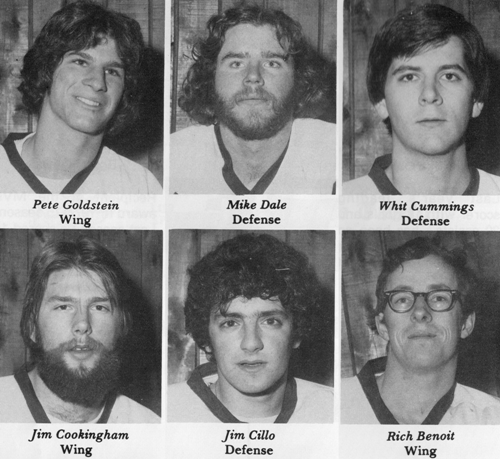
People really did have magnificent flow in the 1970s.

...well, except for Rich Benoit.

The December 14, 1976 Daily Collegian, unfortunately, only gives the events of that Sunday evening in Allentown a gloss-over treatment in the back half of an article also covering a 4-3 win at Delaware the day before the game with LU.


The Lions were involved in another close game against Lehigh but failed in a comeback bid and were defeated 7-5.

"After a strong second period we tied the score 3-3 and thought we could keep the momentum going in the third period," [head coach Bob] Hettema said. "We thought we were going to take over and skate them into the ice but instead we began to tire."

The Lions did appear to be taking the momentum away from Lehigh when Tom Horgas scored the go-ahead goal at 1:18 in the final period. But when Lehigh matched that goal a few minutes later, the partisan crowd spurred the Engineers on to victory.

Bill Richardson was in goal and stopped 42 shots. The Lion attack was balanced with Jerry Fry, Terry Brownschidle, Jim Lynch, Tom Horgas and [Bill] Galli scoring.


Lehigh, helped by the come-from-behind win, finished 11-5-0 that season, including a 6-4 win at Penn State in a rematch on January 23, 1977. In a situation mirrored by Northeast PA neighbor Scranton during its failed NCAA DIII run two decades later, the Engineers' schedule was an odd mish-mash of club teams like PSU, Delaware and West Chester, as well as varsity programs including Fairfield, Iona and Cortland State. Arguably, LU's most impressive results were 9-2 and 11-1 trouncings of RIT on February 19th and 20th, 1977. The Tigers, now an NCAA DI program of course, would go on to win national championships in 1983 (DII) and 1985 (DIII).

After 1976-1977, Penn State and Lehigh met five more times over the next few years, with the Icers finding increasing amounts of success, starting with the schools splitting a pair of meetings in 1977-1978. PSU then won at the Ice Palace on February 16, 1980, and twice more at the first two Nittany Lion Invitational Tournaments at the then-new Ice Pavilion on February 13, 1982 and January 21, 1983. The scores of those NLIT meetings were 7-4 and 12-3, a far cry from just a few years earlier when the Engineers were too steep of a hill for Penn State's puckmen.

The sudden reversal of results, unfortunately, said as much about Lehigh as it did about Penn State. By the end of the 1985-1986 season, and due to "the tension of Title IX compliance and other financial pressures [i.e., division adjustment, staffing and recruiting, league affiliation, travel and arena]," the program "faded from the athletics department’s agenda." The Icers wound up with a 4-6-1 record against LU's varsity hockey experiment.

Five years later, in 1991, the school rebooted with a club program and played one of their first games on November 3rd of that year at the Ice Pavilion against an Icers team well established as one of the giants of non-varsity hockey by that point. Predictably, Penn State cruised to a 9-1 win in what stands as the last tilt between the Icers and LU. Scott Shell had a hat trick that night, supported by two Mark Konchar goals and a 3-on-5 shorty by Brad Russell.

That Lehigh program, now unfortunately called the Mountain Hawks, has continued to develop over the last 22 years. It joined the ACHA in 1996, increased its budget several times over, and grew its association with a now-cooperative athletic department. This past season, while playing in the ACHA Division 1 ECHA - a conference that, by the way, includes Penn State Berks - LU went 15-13-1 under first-year coach Tom Laessig, the father of Ice Lions alumnus T.J. Laessig and rising Ice Lions junior forward Neil Laessig.

Although it took a couple generations, the demise and rebirth of hockey at both institutions, and several other dramatic shifts in circumstances, it appears that Penn State and Lehigh finally have a relationship worthy of their proximity and respective histories.

Monday, April 22, 2013

Three Stars: April 15-21


3. Sara Evans to Headline Pegula Ice Arena Show
(Onward State)

I thought about writing a stand-alone post to mark the first non-hockey event scheduled for Pegula Ice Arena, but...
  1. A family-themed skating show headlined by country star Sara Evans isn't really my thing, and I'd probably do a terrible job feigning interest. No offense intended if you're excited about it.
  2. Penn State basketball bloggers don't write about concerts at the Bryce Jordan Center, unless one forces the team to practice in the IM Building on crooked hoops. To the best of my knowledge, Ms. Evans and the figure skaters won't go full Bon Jovi on us.
  3. Onward State covered it just fine.
That said, it's nice to see the arena serve a broader purpose than hockey (cue audio of Joe Battista saying "it will be an asset not just for hockey, but for the entire community," which he says only marginally less often than "steep as code allows" in reference to the PIA's student section). Tickets for the show, called the Musselman's Apple Sauce Family Skating Tribute, go on sale September 3rd. The event is on November 3rd at 5:00 p.m. and will be broadcast on NBC November 24th at 4:00 p.m.

2. Sabres' owner keeps hockey comments brief
(Buffalo Business First)

The groundbreaking ceremony for the Terry Pegula-financed HarborCenter complex in Buffalo is old news - it was covered in last week's Three Stars - but James Fink of Buffalo Business First hit a pertinent angle unexplored by others, and his article wasn't on the TYT radar until after the previous post was up, so...
A Penn State alumni [eef... "alumni" is plural... hate that one] and major underwriter of its hockey program — including financing the construction of the Pegula Arena in State College, Pegula said he’d love to see the team play a local college at the HarborCenter’s main 1,800-seat arena or in First Niagara Center in the future.
Canisius has been in negotiations to move into HarborCenter, but hopefully I'm not alone in apathy towards the idea of a Golden Griffins-Nittany Lions matchup in an 1,800-seater. If it's all the same to TPegs, what about Cornell at the First Niagara Center? Less local, sure, but also much more compelling.

1. Penn State Hockey: Pegula Ice Arena construction looking "very good"
(PennLive)

Penn State gave a media tour of the Pegula Ice Arena on Saturday morning before football's Blue-White Game, and TYT continued its run as the only PSU hockey-credentialed entity to never once have been invited inside the facility. While I believe I deserve better, I've come to the realization that, for whatever reason, Battista and company are bothered by my existence and that I'll most likely have to adjust to life without access going forward. If that involves traveling to more road games next year, since I've never once had an issue getting a credential from an opponent (provided, of course, that PSU doesn't sabotage my application, as was attempted for the Philadelphia College Hockey Faceoff against Vermont back in January), so be it.

Anyway, as far as I've seen (as of Sunday night), the tour has only produced three puff pieces, and - based on the photos and video that were part of those - there were definitely more than three people present Saturday morning. So it's PSU's loss, I guess. I would have made it four puff pieces, and last I checked, a post to a small audience is better PR than no post to a large one.

I'm giving Greg Pickel of PennLive the "official" link, because his was the most comprehensive story, but be sure to check out the video StateCollege.com's Ben Jones took on the tour, as well as the third write-up, from the Pittsburgh Tribune-Review's Scott Brown. Both Pickel's and Brown's articles have attached photo galleries, and Brown presents an additional item of note:
Battista said he has received season-ticket orders for 3,000 of the 5,000 seats that will be sold to the general public.
Nice.

Best of the Rest

Former Icer Josh Daley finished fourth on Wisconsin-Stevens Point in scoring

UW-Stevens Point men's hockey announces team awards
(uwsp.edu)

Someday, when I'm done being lazy, I'll do a full update on the December post covering the players who transferred away from Penn State after not making the jump from the Icers and Lady Icers to the NCAA men's and women's teams. For now, here's some news on one such player, Pittsburgh-native forward Josh Daley, who is now at NCAA Division III Wisconsin-Stevens Point after spending 2011-2012 with the Icers.

Daley got off to a slow start this year, thanks mostly to irregular appearances in the lineup, but came on strong over the second half of the season. He finished with eight goals and 19 points for a squad that went 15-11-1 overall, a run that culminated with his recently being named Most Improved Player at the Pointers' postseason banquet. Without a doubt, the marketing major will be considered a key part of UWSP's nucleus next year, as the team returns its top five scorers, top two defensemen and starting goaltender.

Force-Waterloo series offers glimpse into Big Ten's future
(The Forum of Fargo-Moorhead)

Perceptive Fargo Force writer Chris Murphy noted the several future Big Ten rivals participating in the USHL first-round playoff series between the Force and Waterloo Black Hawks - led 2-1 by Waterloo after a game three win Sunday afternoon - including Penn State entry Eamon McAdam. Others are Fargo's Gabe Guertler (Minnesota) and Dave Gust (Ohio State), as well as Waterloo's Justin Kloos (Minnesota), Taylor Cammarata (Minnesota) and Zach Stepan (Ohio State).


(Deadly Nuts)

Undoubtedly, Gust and Stepan joined the rest of the hockey world in being shocked at Ohio State's firing of head coach Mark Osiecki last Monday. Osiecki, almost universally considered a rising star in the coaching world, seemed to have the perpetually-underachieving Buckeyes finally moving in the right direction, as noted by many over the last week, including Deadly Nuts. Some have speculated that Osiecki was let go so that OSU can hire newly-unemployed former Denver coach George Gwozdecky... but as someone who believes that coaching careers follow a rise-peak-decline curve not unlike the athletes they mentor, I'd honestly rather have Osiecki at this point. In what looks like a boring offseason on tap (compared to the last couple years anyway), the Buckeyes' coaching search will undoubtedly be one major story to watch.

For whatever it may be worth, the change in Columbus means that Guy Gadowsky will not be the newest coach in the Big Ten during the coming season.

Yep, that's a hockey house

Cal U hockey players facing drug charges
(Cal Times)

Brothers Jesse and Steven Powell, both hockey players at California (PA), were arrested last Tuesday and charged with dealing marijuana out of the hockey house at Cal (if you're not familiar with the term "hockey house," it's pretty much what you think, see above for reference). During a raid, police discovered roughly seven pounds of herb being delivered to the brothers - I believe that falls under the statutory definition of "shitload" - as well as two more pounds and $13,000 already on the premises. A preliminary hearing for the Powells will take place on Thursday.

In what could be viewed as a knee-jerk reaction, and likely because five other players lived with the Powells at the hockey house, the university responded to the arrests by suspending the operations of all three of the Vulcans' hockey teams including, as reported by CBSSports.com, the school's ACHA Division 2 women's team. Cal's women, the first-ever opponent for Penn State's ACHA D2 women back in October, spent much of the 2012-2013 season ranked first in the East Region and qualified for the ACHA National Tournament in Ashburn, VA last month. Similarly, Cal's top men's team, which plays in ACHA D3 and in the College Hockey East conference with the squads at PSU-Altoona and PSU-Behrend, finished the season as the Atlantic Region's number one team and also qualified for its ACHA championship playoffs, held in Springfield, MO March 12th through 16th.

Basically, we're talking about a quality hockey operation, and one that's never been implicated in any wrongdoing until now. Here's hoping that any investigations find that the issue was limited to the Powells - if they are, in fact, guilty of a crime, because this is America and they are innocent until proven otherwise - and that all three teams are reinstated in time for the coming season.

...but seriously, that's a lot of pot.

All-American Teams and All-Region Teams
(achahockey.org)

Congratulations to PSU-Brandywine defenseman Joe Naselli, who was named to the ACHA Division 3 All-Atlantic Region Third Team. Naselli, a senior from Media, PA, posted 13 goals and 32 points in 28 games this past season, helping Brandywine to a 19-9-0 record and a berth in the Atlantic Region tournament.

I suppose I would be remiss if I didn't follow up the previous story by mentioning that six different Cal players appear on the All-Atlantic Region teams, including goaltender Zach Stewart, who was also a first-team All-American. Additionally, Vulcans head coach Justin Berger was the Atlantic Region's coach of the year.

Penn State 2012-13 Women's Hockey banquet video
(Facebook)

If I had it to do all over again, I'd develop an aptitude for video production like Vince Chandler, who was nice enough to share the women's team's highlight video he put together for their postseason banquet.

@MarkHorgas
(Twitter)

Last Wednesday, PSU hockey insider Mark Horgas dropped the news that the Pegula Ice Arena will not, as was planned, include a stand-alone Tim Horton's location. A Subway, of all things, will now occupy the space previously set aside for the cyber cafe, although Tim Horton's coffee will still be served at concession stands.

As someone of the opinion that Tim Horton's, while good, is only held in such high esteem by the hockey world because it bears the name of a Hockey Hall of Fame inductee, I'm going to drop a yawn on this development while saying that Dunkin has better food and Starbucks has better coffee. Come at me, bro.

Women's hockey announces its captains for the 2013-14 season; four players will serve in the leadership role
(ritatletics.com)

Forwards Celeste Brown and Lindsay Grigg will be the captains for CHA rival RIT next season, while defenders Melissa Bromley and Morgan Scoyne will don the A for the Tigers. The four take over for a triumvirate of graduating 2012-2013 captains: Kim Schlattman, Ariane Yokoyama and Tenecia Hiller.

Penn State, of course, returns all three of its letter-wearers in captain Taylor Gross and alternates (yes, alternates) Jenna Welch and Lindsay Reihl, so don't expect a similar announcement from the bowels of the Jordan Center anytime soon.


Plan to preserve Ice Zone fails
(Youngstown Vindicator)

And finally, a last-ditch effort to save the Ice Zone in Boardman, OH - a ridiculous scheme that attempted to sell 1,000 season tickets for the USHL's Youngstown Phantoms through families who use the rink - failed (try to contain your shock long enough to finish this post), and the facility will close for good between May 15th and early June.

The Ice Zone hosted the 2007 ACHA Division 1 National Tournament, which saw the Icers qualify for a record tenth straight championship game, only to be dismantled 5-1 by future ACHA hall-of-famer Will McMahon and Oakland. Earlier that season, the Ice Zone was the site of the 2006 ACHA Showcase, an event that also included Penn State. The Icers' final game of the showcase (following a loss to Oklahoma and a win over Minot State) was against a Weber State team featuring defenseman Aaron Dufford, the great grandson of former Nittany Lions varsity star John Dufford. With the elder Dufford in attendance, PSU topped the Wildcats 5-1.