Showing posts with label New Hampshire. Show all posts

Tuesday, May 28, 2013

Stacked NCAA Women's Schedule Announced

Hannah Hoenshell and the Nittany Lions once again host Mercyhurst on February 15th and 16th, 2014

Penn State has officially announced its second-ever NCAA women's slate, and the first at the Pegula Ice Arena. Without further delay, here it is (* denotes College Hockey America games):

Date
TimeOpponentLocation
Fri. Oct. 4
7:00 p.m.
at Vermont
Gutterson Fieldhouse // Burlington, VT
Sat. Oct. 5
3:00 p.m.
at Vermont
Gutterson Fieldhouse // Burlington, VT
Fri. Oct. 11
TBA
at Quinnipiac
TD Bank Sports Center // Hamden, CT
Sat. Oct. 12
TBA
at Quinnipiac
TD Bank Sports Center // Hamden, CT
Fri. Oct. 18
7:00 p.m.
Union
Pegula Ice Arena // University Park, PA
Sat. Oct. 19
2:00 p.m.
Union
Pegula Ice Arena // University Park, PA
Sat. Oct. 26
7:00 p.m.
New Hampshire
Pegula Ice Arena // University Park, PA
Sun. Oct. 27
2:00 p.m.
New Hampshire
Pegula Ice Arena // University Park, PA
Thu. Oct. 31
7:00 p.m.
Robert Morris*
Pegula Ice Arena // University Park, PA
Fri. Nov. 1
4:00 p.m.
Robert Morris*
Pegula Ice Arena // University Park, PA
Sat. Nov. 9
2:00 p.m.
Syracuse*
Pegula Ice Arena // University Park, PA
Sun. Nov. 10
2:00 p.m.
Syracuse*
Pegula Ice Arena // University Park, PA
Fri. Nov. 15
7:00 p.m.
at RIT*
Ritter Ice Arena // Henrietta, NY
Sat. Nov. 16
7:00 p.m.
at RIT*
Ritter Ice Arena // Henrietta, NY
Fri. Nov. 22
TBA
at Lindenwood*
Lindenwood Ice Arena // St. Charles, MO
Sat. Nov. 23
TBA
at Lindenwood*
Lindenwood Ice Arena // St. Charles, MO
Sat. Nov. 30
2:00 p.m.
Maine
Pegula Ice Arena // University Park, PA
Fri. Dec. 6
3:00 p.m.
at Mercyhurst*
Mercyhurst Ice Center // Erie, PA
Sat. Dec. 7
2:00 p.m.
at Mercyhurst*
Mercyhurst Ice Center // Erie, PA
Fri. Jan. 3
7:00 p.m.
at Ohio State
OSU Ice Rink // Columbus, OH
Sat. Jan. 4
7:00 p.m.
at Ohio State
OSU Ice Rink // Columbus, OH
Fri. Jan. 10
7:00 p.m.
Colgate
Pegula Ice Arena // University Park, PA
Sat. Jan. 11
2:00 p.m.
Colgate
Pegula Ice Arena // University Park, PA
Fri. Jan. 24
TBA
at Syracuse*
Tennity Ice Pavilion // Syracuse, NY
Sat. Jan. 25
TBA
at Syracuse*
Tennity Ice Pavilion // Syracuse, NY
Tue. Jan. 28
7:00 p.m.
at Princeton
Hobey Baker Memorial Rink // Princeton, NJ
Fri. Jan. 31
7:00 p.m.
RIT*
Pegula Ice Arena // University Park, PA
Sat. Feb. 1
2:00 p.m.
RIT*
Pegula Ice Arena // University Park, PA
Sat. Feb. 8
2:00 p.m.
Lindenwood*
Pegula Ice Arena // University Park, PA
Sun. Feb. 9
2:00 p.m.
Lindenwood*
Pegula Ice Arena // University Park, PA
Sat. Feb. 15
2:00 p.m.
Mercyhurst*
Pegula Ice Arena // University Park, PA
Sun. Feb. 16
1:00 p.m.
Mercyhurst*
Pegula Ice Arena // University Park, PA
Fri. Feb. 21
TBA
at Robert Morris*
Island Sports Center // Neville Twp., PA
Sat. Feb. 22
TBA
at Robert Morris*
Island Sports Center // Neville Twp., PA

The CHA Tournament, once again, will be played entirely at campus sites. The sixth-place team and the fifth-place team will travel, respectively, to play the teams finishing third and fourth in the standings for a pair of best-of-three series over the February 28th through March 2nd weekend. The winners then will travel to the home of the CHA regular-season champion to meet the top two seeds for the semifinals (March 6th) and championship game (March 8th).

In a nice touch, a video was produced with head coach Josh Brandwene's comments concerning the schedule, so let's work that in here. Seriously, it's 3:16 long, not the usual throwaway for an occasion like this, so get on it.


The schedule takes on a decidedly streaky flavor, with an early eight-game homestand between October 18th and November 10th followed immediately by a run of eight away games in nine overall between November 15th and January 4th. The Nittany Lions will also play 60 percent of their CHA home games during a late-season stretch at the Pegula Ice Arena between January 31st and February 16th.

The 14 out-of-conference games show that, once and for all, the kid gloves are off - the likes of Division III Chatham and Division I (kind of) Sacred Heart have been replaced by a solid collection of Hockey East and ECAC schools like Quinnipiac, New Hampshire, Maine and Colgate. QU's women, much like their male counterparts, have enjoyed a rather quick ascendancy under head coach Rick Seeley. The Bobcats won just three times in 2008-2009, but haven't won fewer than 19 since then. A big part of that success has been senior forward Kelly Babstock, who scored 28 goals among her 55 points last season, good for 8th and 11th in the nation. New Hampshire finished an uncharacteristic 14-16-4 last season, but the 1998 AWCHA national champs remain a traditional power and feature sophomore defender Alexis Crossley, an all-Hockey East selection last season and a gold medalist with Team Canada at the 2012 Women's U18 World Championships.

Other Hockey East (Vermont) and ECAC (Union, Princeton) opponents will reprise their slots on last year's schedule. The Nittany Lions went 1-4-0 against that collection of teams in 2012-2013, with the win a historic 5-3 triumph at UVM last October 6th in the program's first NCAA game behind two Micayla Catanzariti goals. Union is also a notable opponent for the presence of star goalie Shenae Lundberg who, like Crossley, owns a gold medal from the Women's U18 World Championships (2011, Team USA) and who also played for PSU assistant Casey McCullion at Deerfield Academy in 2007-2008.

In her second straight season opener at UVM, Micayla Catanzariti will aim for a repeat of last year's win

Ohio State will become the first-ever WCHA opponent for the Nittany Lions, and of course is an exciting addition for that university's status as Penn State's biggest rival over the last couple decades. The Buckeyes - who interestingly enough, have been rumored to join the CHA off and on in the past - finished 19-15-3 last year and are decidedly on the rise under former Robert Morris coach Nate Handrahan. Perhaps even more impressively than any of their wins, OSU managed to hang within two goals of Minnesota on February 9th. The Gophers were undefeated (41-0-0) national champions last season, and featured Patty Kazmeier Award winner Amanda Kessel, so yeah, that's actually kind of good. Ohio State did register wins over titans Wisconsin (3-1 on November 17th) and North Dakota (5-3 on October 12th) and will certainly be one of the Nittany Lions' biggest tests to date.

CHA contests, of course, remain the bulk of the schedule, and after seeing the five league opponents for the first time last year, it's pretty safe to say that the conference is stronger than its ever been as it looks to gain an NCAA Tournament autobid for 2014-2015. Mercyhurst re-asserted itself as the dominant team by winning both the regular season and conference championships and adding their usual NCAA appearance in 2012-2013 after Robert Morris stunned the Lakers to win the CHA Tournament two seasons ago. Syracuse emerged as a top-tier team, finishing second in both the standings and the playoffs. Along with Penn State, RIT and Lindenwood joined up as part of their transitions to NCAA Division I and were both highly competitive. The Lions were particularly notable in that regard, as they suddenly started chipping off big victories over the second half of the season (a sweep of RMU and a win at Syracuse to name three) after a 10-44-1 start to their time in DI that included only three wins against DI competition.

Beyond the schedule, Penn State also reiterated ticket information for the inaugural Pegula Ice Arena season:
Tickets for the inaugural Pegula Ice Arena season can be purchased in a season ticket package ($50) for all 17 games or on a game day basis of $5 by calling 1-800-NITTANY (648-8269) or visiting the Bryce Jordan Center ticket office.

Seating at Pegula Ice Arena will be general admission in the lower bowl. A Nittany Lion Club donation is not required for season tickets. Students will be free to all regular-season games, while men's hockey premium season ticket holders in the loge, club and suite levels will receive complimentary women's hockey season tickets.
I'll go ahead and say it: $50 for a front row seat (if you get there early enough, see the general admission thing) to Penn State's home schedule might be the best deal in sports.

Thursday, May 16, 2013

Women's Games Revealed Against Syracuse, UNH

Taylor Gross and PSU will look for a first win vs. Allie LaCombe and Syracuse on November 9th

With 2013-2014 men's hockey schedules across NCAA Division I coming out almost daily and officially taking their first choice of dates and times at their schools' arenas, it seemed only natural that women's schedules would start to follow at some point. Welcome to "some point."

College Hockey America rival Syracuse - which I suppose didn't have to wait for the men, as the school has no NCAA men's program - released its 2013-2014 schedule on Wednesday. This, of course, also revealed 20 percent of Penn State's conference schedule:

Saturday, November 9, 2013: Syracuse at Penn State
Sunday, November 10, 2013: Syracuse at Penn State
Friday, January 24, 2014: Penn State at Syracuse
Saturday, January 25, 2014: Penn State at Syracuse

Last season, the Orange swept the season series from PSU, spoiling the Nittany Lions' first NCAA-era home games with a 10-0 weekend shutout before taking two more at the Tennity Ice Pavilion in January. SU finished a sturdy 20-15-1 overall and 13-6-1 in the CHA, good for second place in the league standings, and beat RIT 2-1 in overtime in the conference tournament semifinals before falling to Mercyhurst in the championship game. Leading scorer Holly Carrie-Mattimoe and ten-goal defender Jacquie Greco have departed, but the rest of the team, including Shiann Darkangelo (third in the CHA with 16 goals last season), Akane Hosoyamada (named the CHA's best blueliner for 2012-2013) and Kallie Billadeau (1.56 goals against average, 0.940 save percentage, all-CHA first team honors), returns. Without a doubt, Cuse will be title favorites entering the season alongside, as always, the Lakers.

In addition to the PSU-SU games, the Syracuse schedule announcement also shared the dates of the 2014 CHA Tournament. From February 28th through March 2nd, the sixth and fifth place teams will travel to play, respectively, the third and fourth place teams in a pair of best-of-three quarterfinal series. The two winners will then play the first and second place teams on the ice of the CHA's regular season champion on March 7th, with the winners of those semifinals meeting for the championship the next day.

Beyond Syracuse, and according to USCHO message board poster Hux (who is credible enough in my assessment for me to run with this news), Hockey East's New Hampshire will visit Pegula Ice Arena on Saturday, October 26th at 7:00 p.m. and Sunday, October 27th at 2:00 p.m.

In UNH, the Nittany Lions will welcome (arguably and depending on the rest of the schedule, of course) the highest-caliber non-conference opponent to visit PSU so far. The Wildcats program has been around since 1977 and won the first women's national championship ever in 1998, sanctioned by the American Women's College Hockey Alliance ahead of the NCAA's involvement beginning in 2001. From 2006 through 2010, New Hampshire qualified for five straight NCAA Tournaments, and the program has won ten Hockey East regular season or tournament championships since 2004. While the Wildcats have fallen off of that form a bit in the last couple years - they went 14-16-4 overall and 10-8-3 in Hockey East in 2012-2013 - they'll look move back towards the top of DI behind sophomore defender Alexis Crossley and junior goaltender Jenn Gilligan, both of whom earned all-conference honors this past season.

High-powered Alexis Crossley will lead New Hampshire into Pegula Ice Arena in October

Crossley, in fact, has at least three biographical details in common with Pittsburgh Penguins superstar Sidney Crosby: a hometown of Cole Harbour, Nova Scotia, a stop to play at Shattuck-St. Mary's and a gold medal-winning goal from a major international competition while wearing the maple leaf. In Crossley's case, that last distinction came from the 2012 Women's U18 World Championships, where she opened the scoring in a 3-0 shutout of Team USA to take the tournament. Not quite as dramatic as Crosby's OT-er at the Vancouver Olympics, but impressive nevertheless.

The major downside? The Saturday game more or less runs directly opposite the men's game against Vermont at Philadelphia's Wells Fargo Center, as well as the football team's game at Ohio State. Still, this will be an intriguing enough matchup and benchmarking opportunity to consider spending that evening with Josh Brandwene's squad.

Connecticut transfers Taylor Gross, Nicole Paniccia and Jenna Welch, incidentally, all have experience against their former league opponent while the trio played for the Huskies from 2010 through 2012. Welch played in all six games against UNH during her two seasons in Storrs, going 3-3-0 and potting a goal in a 6-3 UConn win on February 5, 2012. Paniccia made 20 saves in that contest to collect the victory, but backed up Alexandra Garcia in each of the other games. Gross was already a Lady Icer by that point, but she won twice against the Wildcats in three 2010-2011 meetings, assisting on the game's only goal on November 13, 2010 and scoring herself in a 2-1 triumph the next day.

As these are the first six confirmed 2013-2014 dates for the women, I've updated the W Schedules/Results page and will continue to do so until Penn State announces the full slate.

Tuesday, April 2, 2013

A Day at NCAA Regionals


A few reflections on a day spent in Toledo, OH for the NCAA Tournament's Midwest Regional first round on Saturday...

For someone more used to the determination of an ACHA national champion than to the similar process of the NCAA, and in the interest of informing other Penn Staters, it may help to start with a few differences between the two, because ACHA National Tournaments are in fact significantly different than what we'll eventually see in NCAA Division I. First off, there's the number of teams - in the opening two days of the ACHA Division 1 championships, attendees cross paths with 20 different teams in the same ice facility, while in the NCAA, there are never more than four teams at any one site, which doesn't really offer nearly as much in terms of the sheer spectacle (I mean really, it's two games one day, one game the next day... as someone used to eight hockey games in one day on two adjacent sheets at ACHAs, big deal).

The second major difference is closeness. With the ACHA, it's not at all uncommon to mingle with teams watching other games from the stands or leaning up against the glass, while at NCAAs, teams maintain that degree of separation that comes in big-time professional or college arenas. Additionally, in the ACHA, people are sort of taken aback by the presence of "pure" fans or media - really, people in attendance who don't have a relative on the team and aren't part of a team's staff aren't all that common, even at nationals (at the recent ACHA women's tournament, I had issues getting a complimentary tournament pass, largely because the idea of someone like me independently covering the tournament was completely off the map for the event's staff).

I'm not trying to pass qualitative judgment on those differences here. They just are.

That last difference - the presence of fans - is something quite unique in NCAA hockey, particularly at the Frozen Four.

I attended the 2010 Frozen Four, and made a fairly egregious rookie mistake: I wore an RIT shirt, as they were my favorite team in Detroit that year. Long story short, despite an ignored up-front explanation of my status as a Penn State alumnus, I ended up spending most of the Tigers' blowout loss to Wisconsin talking about RIT to four bottled New Hampshire fans in front of me. How many people go there? What are its most competitive majors? I broke down and faked knowledge of my "alma mater" well enough to satisfy them, then wore an Icers jersey when I returned for the championship game two days later. Lesson learned. You don't pick a "tournament team" in NCAA hockey - it should probably be noted that UNH wasn't in the Frozen Four that year, yet four guys in head-to-toe Wildcat gear made sure the school was represented there.

Regionals are the same way, on a much smaller scale. In Toledo, Miami and Notre Dame had the best numbers, as one would expect due to proximity, while Minnesota State and St. Cloud State were much less represented, but certainly present. Host Bowling Green had a few fans there, as did Ohio State (with hockey-specific gear, so I'm reasonably confident that they weren't merely a few of the Walmart Buckeyes that dominate the state, not to mention the fact that they would have had to skip OSU's basketball team in that NCAA Tournament to be there). Relatively close Michigan had a few, and numerous other schools had singles, including every remaining Big Ten school - my hoodie and some serial killer-looking guy in a 2010 Capital One Bowl t-shirt took up for PSU.

No, there weren't 20 teams there, but in a way, there were even more than that. And that makes it a blast. Even when they're drunk and think you went to some other school, it's fun interacting with fans from around the country who you wouldn't ever meet but for the NCAA Tournament. This time around, I sat next to a Miami fan who, it has to be said, knew next to nothing about hockey, but was as passionate about it as anyone I've ever seen, in talking during the game, belting out the school fight song (which I believe uses the phrase "love and honor" about 72 times) and participating in all of the usual chants (including "it's all your fault" at the opposing goalie after an empty-netter, which doesn't make a ton of sense to me). I didn't want to root for the RedHawks against Minnesota State, but enthusiasm is contagious, as is often said. That same Miami fan was going hard for St. Cloud State over Notre Dame, and got exactly what she wished for, at least until the Huskies throttled the RedHawks the next day to represent the region in the Frozen Four.

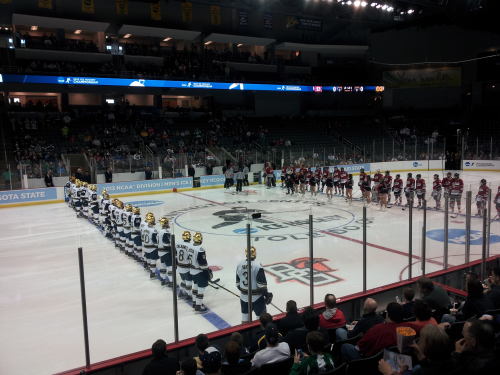
St. Cloud State (red) crushed top seed Notre Dame, then Miami, to reach the Frozen Four

The present NCAA Tournament format, which divides 16 teams into four regions, with the four regional winners meeting at the Frozen Four, is frequently criticized, largely because of punchline-worthy attendance numbers. In other words, there are fans there, they represent many different schools proudly, there just aren't enough of them. Toledo's first-round attendance was 2,988 in a building seating 7,389, the second-lowest number of the four regionals. The West Region in Grand Rapids, MI brought up the rear with 2,289 in 10,834-seat Van Andel Arena. The East and Northeast Regions were much better with 6,253 (of 11,940) in Providence, RI and 8,049 (of 9,852) in Manchester, NH.

The hockey is great, it's entertaining to attend, the atmosphere can be fun... so what's the problem? Why doesn't the draw of the NCAA hockey regionals measure up to, say, the NCAA basketball tournament, or even the Frozen Four (that 2010 event had 37,592 at Ford Field's championship game, a record draw for an indoor hockey game)?

Interestingly enough, I recently attended a segment of the basketball tournament as well, the second and third-round sub-regional in Auburn Hills, MI, which I believe can offer some insight, as there's no perceived attendance issue there. Notably...
  • Despite the immense popularity of the NCAA basketball tournament in our society - it's probably the U.S.' second-biggest sporting event behind the Super Bowl - the second-round games were not sold out. Thursday afternoon's Session 1 (Michigan State-Valparaiso and Memphis-St. Mary's) drew 18,863 to the 22,076-seat Palace, while the evening Session 2 (Michigan-South Dakota State and Akron-VCU) pulled 19,829.
  • Each session had the benefit of one of the two most popular schools in a major metropolitan area. Without that, the numbers take a significant hit. None of the six other teams there had significantly greater support in their corner than Miami and Notre Dame in hockey. In fact, each school was only allotted 550 tickets for their "official" contingent, and it was extremely uncommon to see fans from the "other six" outside of their designated sections.
  • Don't overlook the "major metropolitan area" part of that last bullet. Stunningly, the Detroit area is able to pull more casually-interested locals than the Toledo area (while the two cities are very close to each other, it's still not a drive generally made on a whim).
  • There were eight teams represented there - while the two sessions are separate tickets, tons of fans paid for both. That crossover is something that hockey doesn't get, with each regional just half the size of a basketball sub-regional.
One frequently proposed solution to hockey's attendance woes is to move the tournament back to campus sites, a position recently advocated by my buddy Eric Burton.
It’s that time a year again, Division I college hockey soon will be taking center stage in the NCAA regionals playing in half empty arenas, in venues in cities across the USA.

It’s a yearly occurrence for college hockey, because we can’t have any more regionals on campus. God forbid, we can’t have playoff games in rowdy arenas stuffed with rabid fans.

The NCAA wants regional games played in arenas posing as quite emotionless mausoleums, all under the guise of the regional being held at “neutral” sites.


[In]essence, yearly, the NCAA is giving the eastern teams in the NCAA Division I hockey tournament home games. It’s no wonder they don’t want to move the regionals back on campus. Why should they? They might have to play a Michigan, North Dakota, Minnesota, Denver at their home arena. We can’t have that, they might not have an easier path to the Frozen Four.
That strikes me as shortsighted and driven by self-interest with a healthy dose of paranoia (why does the NCAA favor eastern teams... oh right, because his team isn't an eastern team.), particularly as long as the volatile PairWise Rankings are used to determine things. Under PWR, flipping a game result or two can turn the entire seeding on its ear, and that's not a decisive enough "win" in my opinion to take the step of forcing a deserving team to play a road game in the NCAA Tournament. The NCAA Tournament isn't a conference, where two teams played a full, generally identical round robin schedule and one had a better record than the other, it's "hey, if that game between two teams not in the tournament back in November had gone the other way and your opponent was a Team Under Consideration, we'd be playing at your barn instead of ours... I'm sure you'll find it hilarious later."


I believe instead that hockey should take a few lessons from basketball, which seems a fairly obvious exercise. Limit things to an East and a West Regional. Invite eight teams from each to a major-city neutral site for four games on day one, and two more on day two. Both day two winners advance to the Frozen Four. Continue the practice of placing teams to maximize attendance, because again, the idea of "bracket integrity" seems like a silly concept, given the fragility of PWR.

As long as the two host cities aren't Boston and St. Paul every year (I'm thinking something like Denver, Chicago, Minneapolis-St. Paul, Detroit in the west, Boston, New York, Philadelphia, Pittsburgh in the east, with sites furthest from the Frozen Four preferred on a year-to-year basis to keep this thing accessible), I think it's a great concept. Neutral sites keep the integrity of the competition and hockey's status as a big-time sport worthy of the distinction intact. Major cities provide a destination experience that Toledo and even campus sites just can't. The system also maintains that co-mingling of people from all over college hockey, what makes this whole thing unique and worth preserving - I have no doubt that campus sites would deter visiting fans and neutrals from attending, even if seats are allocated evenly.

But whatever solutions may or may not be down the road, I actually don't think the present system is all that broken. The NCAA clearly doesn't have too much issue with the attendance, or they'd change things. And I had a good experience as a neutral fan. Did I see the Miami fanbase in its full glory, as I would down at Goggin? No, but the NCAA Tournament experience isn't about that, nor should it be. I can't wait to attend one where I have a strong rooting interest.

Monday, March 25, 2013

The Penn Stater's Guide to the NCAA Tournament III

Welcome to TYT's third annual "I'm a Penn State fan. Who should I root for in the NCAA Tournament?" post. To reiterate the rules: this post is not about prediction, serious analysis, or even personal preference (although that does creep into play on occasion). It's simply an attempt to rank the four schools in each of the four NCAA Tournament regions in terms of their relationship to PSU. Sometimes it involves past events, sometimes it involves future implications. Sometimes there's not a ton to go on, and I'll usually drop those schools somewhere in the middle. But if Penn State is your only concern, this is how I think your rooting interests should play out.

Until Penn State has a direct reason (ie. participation) to care about the NCAA Tournament, I'll defer to others for the hardcore stuff. Western College Hockey Blog, for example, has fantastic previews of each region (East, Northeast, Midwest, West), and I encourage you to go over there for further reading.

The winners of each region, of course, will congregate at the Frozen Four, hosted this year by Pittsburgh's CONSOL Energy Center and Robert Morris University on April 11th (semifinals) and 13th (championship game). It's actually the first of consecutive Frozen Fours to be held in the Keystone State, as 2014's edition will head across the commonwealth to Philadelphia.

Finally, before we get started, here are the tournament brackets (interactive and PDF) from NCAA.com.

East Region (Providence, RI)

1. Quinnipiac vs. 4. Canisius, Saturday 5:30 p.m., ESPN3
2. Boston College vs. 3. Union, Saturday 9:00 p.m., ESPNU
Regional Final, Sunday 6:30 p.m., ESPNU


1. Union. It seems almost crazy now, given what happened subsequently, but I was absolutely pumped by PSU's competitive losses in Schenectady back in November (2-0 and 4-1, with empty-netters in both games). That was at a time when I didn't honestly see a major-conference win coming in NCAA Year One, and suffice it to say, I think Penn State would have a shot at being more than "competitive" today. In last year's version of this post, while discussing the Dutchmen, I said: "It would be pretty cool if the Dutchmen carried something like a Frozen Four appearance from this season into next season's games with the Nittany Lions." And yes, it was. With Union rumored to be making a trip to Pegula Ice Arena next season, I'm saying it again.

2. Canisius. The two Atlantic Hockey teams in the tournament this year both get a bump due to the fact that Penn State was an honorary member of the conference in 2012-2013, going 5-8-0 against AIC, RIT, Air Force, Sacred Heart, Army, Holy Cross, Robert Morris and Connecticut - there's nothing at all wrong with wanting to see the champion of the AHA tournament do well under those circumstances, even if they are up against it with an opening game against top overall seed Quinnipiac. The Golden Griffins also get points for a previous series with the Icers, back when the school played in NCAA Division III. PSU went 2-6-0 in those games, spanning from 1981 until 1995.

3. Quinnipiac. In a weaker region for Penn State interests (see: Midwest), the Bobcats may very well have been number one, due to my new blood bias (hey, we're new blood too, after all). For the little it may be worth now, QU's home TD Bank Sports Center was part of the legendary "get ideas for the PIA" arena tour taken by Penn State leadership, and is generally credited with influencing the "steep as code allows" (finish your drink!) nature of our nearly-complete student section.

4. Boston College. Eef. If you really want to see Boston College win anything (again), go away. If you're still here, it does need to be said that BC's one saving grace is the Eagles' three Pittsburgh natives: starting goalie Parker Milner, stud defenseman Patrick Wey, and freshman blueliner Travis Jeke. Diminutive superstar Johnny Gaudreau, the leading scorer both for BC and for Team USA's gold medal winning entry at this year's World Junior Championships, gets an honorable mention as a Philadelphia-area New Jersey native who played for Team Comcast. The three PA natives are tied with UMass-Lowell's batch as a tournament high.

Northeast Region (Manchester, NH)

1. UMass-Lowell vs. 4. Wisconsin, Friday 4:30 p.m., ESPN3
2. New Hampshire vs. 3. Denver, Friday 8:00 p.m., ESPNU
Regional Final, Saturday 6:30 p.m., ESPNU


1. Wisconsin. Do I really need to explain this one?


In its first NCAA season, Penn State beat a team that is participating in the NCAA Tournament. The fact that the Badgers are also a Big Ten school, and yeah, "rah-rah, go conference," almost seems like an afterthought next to that. Feel free to extrapolate and call UW the overall top seed - I'll be rooting for them against anyone in the field. Could you imagine if Penn State ended up beating the eventual national champions?

2. UMass-Lowell. Things significantly drop off from a Penn State standpoint after the obvious Wisconsin call, but the aforementioned three Pennsylvanians (defenseman Joe Houk of Richboro, goaltender Brian Robbins of Scotrun, forward Terrance Wallin of Yardley) and the new blood factor give the River Hawks the edge over UNH. Lowell, a former Division II superpower that elevated to DI in 1984, has been thoroughly average since then, but has now made consecutive NCAA tournament appearances and won its first Hockey East tournament title on Saturday by ending Jack Parker's legendary career at Boston University. New blood is fun until it gets annoying (see Union, with Quinnipiac setting a land speed record on the way there), and Lowell isn't annoying yet.

3. New Hampshire. If the Wildcats were to take the whole thing, I wouldn't complain. The school, quite accurately dubbed the University of No Hardware by detractors, is always there - UNH has been to 18 of the last 22 NCAA Tournaments and a streak of ten consecutive was snapped last year - but never wins, and is quite possibly the most storied program in college hockey without a national championship. There's not much on either side of the ledger from a Penn State/Pennsylvania perspective though, other than gigantic (6'6", 225 pounds) defenseman Eric Knodel, a West Chester native and a Toronto draft pick. He was selected when Brian Burke was still the Leafs' GM, although that probably goes without saying.

4. Denver. The Pios have always been sort of a nothing team to me. There's no disrespect intended in that statement, DU's obviously one of the most successful programs in college hockey, I just have literally no feelings positively or negatively about them. What drops them to the bottom of the region, then? They're joining the NCHC next year. I get the feeling that Big Ten-NCHC in hockey is going to be like Big Ten-SEC in football for years to come, or at least until the entire conference structure gets reshuffled again. Except hopefully, the Big Ten will be the better conference at hockey.

Midwest Region (Toledo, OH)

1. Notre Dame vs. 4. St. Cloud, Saturday 1:30 p.m., ESPN3
2. Miami vs. 3. Minnesota State, Saturday 5:00 p.m., ESPN3
Regional Final, Sunday 4:00 p.m., ESPNU


1. Notre Dame. It's not an easy call in a region that's absolutely brutal for Penn State interests, but I've always been fond of the fact that once upon a time, the Icers played Notre Dame. The Irish temporarily removed varsity status from its hockey program for a single season, 1983-1984, and scheduled a series in Johnstown against eventual club national champion PSU, with ND taking three points from the weekend. The next season, with Lefty Smith's gang back in the NCAA, the Icers went to South Bend and were swept. Notably, Notre Dame was Joe Battista's second choice of college - try that alternate history on for size, you won't like it - and PSU brass has a good relationship with the school, so you can probably count on the teams meeting at some point. ND's Compton Family Ice Arena was a key influence on the Pegula Ice Arena design as well.

No shame in having the second-nicest arena in college hockey

2. Minnesota State. The Screaming Eagles Mavericks could be considered one of the victims of Penn State's entry into NCAA hockey, as next season they'll be going from the WCHA, the toughest conference in college hockey, to... the WCHA, the fifth-toughest conference in college hockey. Normally, I'd point out that under the new setup, teams like Minnesota State, Lake Superior State and Bowling Green might actually have a better shot at an NCAA bid since one of the WCHA "leftover" teams are guaranteed to go via the autobid, but MSU obviously didn't need that to get in this year, so... uhhh... sorry?

3. Miami. I've generally been fond of the RedHawks, as a relative newcomer to NCAA Division I hockey that is now firmly established in the "club" of national powers (in other words, saying Miami is going to be good or is going to win something no longer receives a sneer in response, as it has for PSU, although the Nittany Lions' 2012-2013 results certainly shut a few people up). Eight straight tournament appearances with two Frozen Fours and one almost-championship will tend to do that. From a 1978 start date, the then-Redskins first made NCAAs in 1993, before things really took off once head coach Enrico Blasi's tenure began in 1999. MU does receive some credit for participation in the Three Rivers Classic this season, although they managed to duck PSU, but... there's that NCHC thing rearing its ugly head again. Without it, Miami is first or second in the region. With it, they're third.

4. St. Cloud State. In the recent past, and in consideration of the fact that former Icers coach Morris Kurtz was a 27-year athletic director at SCSU, the Huskies would almost certainly be somewhere other than last. However, Kurtz retired last June, and... NCHC. Ew.

West Region (St. Paul, MN)

1. Minnesota vs. 4. Yale, Friday 2:00 p.m., ESPNU
2. North Dakota vs. 3. Niagara, Friday 5:30 p.m., ESPNU
Regional Final, Saturday 4:00 p.m., ESPNU


1. Minnesota. With the end of Michigan's 22-year tournament streak this year and the low seed given to Wisconsin (although many are pegging the Badgers as a dark horse, given the 10 wins in 12 tear that got them into this thing), stacked Minnesota has to be considered the favorite to represent the Big Ten deep into NCAAs, and Penn Staters should act accordingly. Since the announcement of the conference's formation, haters have had loads of ammo, thanks to frequently-underperforming programs, as judged by their traditional standards. In 2011, Michigan was the only Big Ten school to qualify for the tournament, although their run to overtime of the national championship game helped alleviate the issue. Last year, Michigan, Michigan State and Minnesota all made it, but only the Gophers managed to win an NCAA Tournament game, two actually, before falling to eventual national champion Boston College in the Frozen Four semifinals. Until the Badgers' late run this season, things once again looked pretty bad for the Big Ten, particularly with usual powers Michigan and Michigan State slumping - but a Gophers national championship leading into Big Ten play next year would help the league's credibility immeasurably.

Bonus reason: Gophers forward Tom Serratore and PSU captain Tommy Olczyk are close friends

2. Niagara. Niagara is a team from mid-major league Atlantic Hockey and received an at-large bid. Not supporting that is un-American, or something. As mentioned under the Canisius entry, AHA teams get extra credit this season due to PSU's 13 games against the conference - it would be nice if the Nittany Lions' competition, or at least the teams that beat that competition to win the AHA regular season (Niagara) and playoff (Canisius) titles, ends up looking good.

3. Yale. The Bulldogs, along with New Hampshire and arguably UMass-Lowell and Minnesota State, stand out as a more or less completely neutral team from a Penn State standpoint. Don't root for them against Minnesota of course, but should Yale stun the Gophs, feel free to pull for them against North Dakota. You could even support them against Niagara, given the lack of truly compelling reasons to support the Purps, if you're a huge fan of junior forward Jesse Root, a Pittsburgh native who is fifth on the team in scoring with 20 points this year.

4. North Dakota. ...and in what's become an annual tradition, the Sioux bring up the rear due to what I'm calling the Eric Burton rule. I'm not sure that I have to elaborate at this point, but if I'm wrong, get at me in the comments. Because it will never stop being funny, here's what happens when the Sioux get eliminated (for those unfamiliar with the context, Michigan's Scooter Vaughan just scored an empty-netter to clinch victory for the Wolverines in the 2011 Frozen Four semifinals):

Sunday, March 17, 2013

D2 Nationals: Day 3 Roundup


Shortly before the Ice Lions closed out their Pool C schedule with a 6-1 win over Marist, Illinois State eliminated PSU and clinched advancement to the semifinals for themselves through a 3-3 tie with Weber State. WSU - just as in the Wildcats' other two nationals games - was careless with the lead, squandering an 2-0 first-period advantage, as well one of 3-2 in the third period. Allen Urbaniak tied the score on both occasions, first at 2-2 with a spectacular takeaway-snipe in the second period, then at 3-3 from Jeremy Gaddo's feed with 8:51 left in regulation. Josh Ambrosat opened the Redbirds' scoring.

The game did come fairly close to delivering the necessary help for Penn State, against long odds. Had Weber State scored in overtime, and had the Ice Lions not given up an otherwise-meaningless late power play goal in their game, PSU and ISU would have had identical records and goals for-goals against numbers - pushing the Pool C tiebreaker to fewest penalty minutes (the outcome of such a hypothetical is unknown, thanks to the ACHA's absolutely horrendous job communicating information regarding the tournament).

As it stands however, the Redbirds win the group and advance to Monday's semifinals, where they'll take on Pool A winner Grand Valley State at 5:30 p.m.

Other Sunday Scores

Pool A: Grand Valley State 6, Arizona State 0
Pool A: Northeastern 8, Maryland 0
Pool B: Michigan State 5, Miami 4 (OT)
Pool B: Connecticut 5, Colorado State 2
Pool D: Utah State 5, New Hampshire 3
Pool D: Saint Louis 7, Bowling Green 4

Final Standings
(x - team has been eliminated)

Pool A
W
LTGFGA+/-Pts.
Grand Valley State
2
1
0
9
2
+7
4
x - Northeastern
2
1
0
13
5
+8
4
x - Arizona State
2
1
0
7
11
-4
4
x - Maryland
0
3
0
2
13
-11
0


Pool B
W
LTGFGA+/-Pts.
Michigan State
3
0
0
13
10
+3
6
x - Connecticut
2
1
0
13
7
+6
4
x - Miami
1
2
0
8
12
-4
2
x - Colorado State
0
3
0
7
12
-5
0


Pool C
W
LTGFGA+/-Pts.
Illinois State
2
0
1
13
6
+7
5
x - Penn State
2
1
0
13
8
+5
4
x - Weber State
1
1
1
13
16
-3
3
x - Marist
0
3
0
10
19
-9
0


Pool D
W
LTGFGA+/-Pts.
Utah State
2
1
0
15
13
+2
4
x - New Hampshire
2
1
0
15
11
+4
4
x - Saint Louis
1
2
0
13
13
0
2
x - Bowling Green
1
2
0
14
20
-6
2

Monday Tournament Schedule

Semifinals

Grand Valley State vs. Illinois State, 5:30 p.m.
Michigan State vs. Utah State, 8:15 p.m.

Saturday, March 16, 2013

D2 Nationals: Day 2 Roundup


While the Ice Lions staved off elimination with a big 7-3 come-from-behind win over Weber State Saturday afternoon, they were hurt by Pool C's other result, which saw Illinois State complete a sweep of the group's top two seeds with a 6-3 win over now-eliminated Marist.

Had Marist won, each Pool C team would have been 1-1-0 entering the final day of the round robin Sunday, obviously setting up a wide-open situation that may have proven advantageous to a PSU team trying to claw back from an opening loss to the Redbirds. As things stand though, ISU is 2-0-0 and also owns a sizable advantage in the goals against tiebreaker. Essentially, Penn State's best hope is a win over Marist tomorrow morning at 11:30 a.m., coupled with a Weber State win over Illinois State in a game beginning at 11:00 a.m. Additionally, PSU will need to allow at least four fewer goals than ISU over the course of those two games.

It's a longshot, but an explosive WSU team can score in bunches, while Marist has only pride left as motivation. It may not be enough at this point, but it's something. And hey, it beats the only alternative that was on the table after day one.

Other Saturday Scores

Pool A: Northeastern 2, Grand Valley State 1
Pool A: Arizona State 3, Maryland 2
Pool B: Michigan State 5, Connecticut 4
Pool B: Miami 4, Colorado State 3 (OT)
Pool D: Bowling Green 6, Utah State 5
Pool D: New Hampshire 4, Saint Louis 2

Current Standings
(x - team has been eliminated)

Pool A
W
LTGFGA+/-Pts.
Arizona State
2
0
0
7
5
+2
4
Grand Valley State
1
1
0
3
2
+1
2
Northeastern
1
1
0
5
5
0
2
x - Maryland
0
2
0
2
5
-3
0


Pool B
W
LTGFGA+/-Pts.
Michigan State
2
0
0
8
6
+2
4
Connecticut
1
1
0
8
5
+3
2
Miami
1
1
0
4
7
-3
2
x - Colorado State
0
2
0
5
7
-2
0


Pool C
W
LTGFGA+/-Pts.
Illinois State
2
0
0
10
3
+7
4
Penn State
1
1
0
7
7
0
2
Weber State
1
1
0
10
13
-3
2
x - Marist
0
2
0
9
13
-4
0


Pool D
W
LTGFGA+/-Pts.
New Hampshire
2
0
0
12
6
+6
4
Utah State
1
1
0
10
10
0
2
Bowling Green
1
1
0
10
13
-3
2
x - Saint Louis
0
2
0
6
9
-3
0

Sunday Tournament Schedule

Pool A

Grand Valley State vs. Arizona State, 2:15 p.m.
Northeastern vs. Maryland, 4:45 p.m.

Pool B

Colorado State vs. Connecticut, 11:15 a.m.
Miami vs. Michigan State, 1:45 p.m.

Pool C

Illinois State vs. Weber State, 11:00 a.m.
Marist vs. Penn State, 11:30 a.m.

Pool D

Bowling Green vs. Saint Louis, 2:00 p.m.
Utah State vs. New Hampshire, 4:30 p.m.

D2 Nationals: Day 1 Roundup


In the Pool C game outside of the Ice Lions' shutout loss to Illinois State, potent Weber State shocked Marist, the group's top seed, 7-6 in overtime. Senior defenseman Reid Mayer ended a wild extra period (and game, for that matter) by intercepting in the Foxes' zone and lasering home the winner. Marist had stormed back from a three-goal deficit late in the second period - including the OT-forcing tally with 30 seconds remaining in regulation.

The result gives PSU a mild boost because, at minimum, the Ice Lions winning their last two pool games (which they'll need to do anyway) would ensure a second loss for Marist. Sure, the team will still need help against Illinois State and possibly against WSU as well, but all things considered, needing help on the third or fourth seed is still better than needing help on the first seed.

Other Friday Scores

Pool A: Grand Valley State 2, Maryland 0
Pool A: Arizona State 4, Northeastern 3
Pool B: Michigan State 3, Colorado State 2 (OT)
Pool B: Connecticut 4, Miami 0
Pool D: New Hampshire 8, Bowling Green 4
Pool D: Utah State 5, Saint Louis 4 (OT)

Current Standings

Pool A
W
LTGFGA+/-Pts.
Grand Valley State
1
0
0
2
0
+2
2
Arizona State
1
0
0
4
3
+1
2
Maryland
0
1
0
0
2
-2
0
Northeastern
0
1
0
3
4
-1
0


Pool B
W
LTGFGA+/-Pts.
Connecticut
1
0
0
4
0
+4
2
Michigan State
1
0
0
3
2
+1
2
Colorado State
0
1
0
2
3
-1
0
Miami
0
1
0
0
4
-4
0


Pool C
W
LTGFGA+/-Pts.
Illinois State
1
0
0
4
0
+4
2
Weber State
1
0
0
7
6
+1
2
Penn State
0
1
0
0
4
-4
0
Marist
0
1
0
6
7
-1
0


Pool D
W
LTGFGA+/-Pts.
New Hampshire
1
0
0
8
4
+4
2
Utah State
1
0
0
5
4
+1
2
Saint Louis
0
1
0
4
5
-1
0
Bowling Green
0
1
0
4
8
-4
0

Saturday Tournament Schedule

Pool A

Grand Valley State vs. Northeastern, 4:00 p.m.
Arizona State vs. Maryland, 4:15 p.m.

Pool B

Michigan State vs. Connecticut, 1:30 p.m.
Miami vs. Colorado State, 3:45 p.m.

Pool C

Marist vs. Illinois State, 1:00 p.m.
Penn State vs. Weber State, 1:15 p.m.

Pool D

Saint Louis vs. New Hampshire, 6:45 p.m.
Utah State vs. Bowling Green, 7:00 p.m.