Tuesday, April 30, 2013

Ice Pavilion to Remain, Purpose Still TBD

The Greenberg Ice Pavilion, shown here shortly after its 1981 opening, will likely receive new life

According to a report by Penn State journalism student Dan Griswold published in the Centre Daily Times, the Greenberg Ice Pavilion will survive beyond the opening of Pegula Ice Arena, although not as an ice rink.
Greenberg Ice Pavilion’s days as a skating facility may be numbered, but the building will not be closed or demolished when construction finishes on a new campus arena in October.

Greenberg is slated to continue operating until shortly after the Pegula Ice Arena is officially completed.

“They want to make sure that everything is fully operational at Pegula,” said Paul Ruskin, of Penn State’s Office of Physical Plant.

Once Pegula is up and running, the current plan for Greenberg, which has housed Penn State hockey teams since 1980, is to use it for other intercollegiate sports activities.

“There are committees which will be meeting for the next few months to determine just what that purpose will be,” said Ruskin.
As someone who will always be nostalgic for the Ice Pavilion, it's good to hear that the building will remain standing, even if it won't contain ice (which was never a realistic outcome). Years from now, it would be fantastic if the [whatever the building will eventually be called] is well known for something like being Penn State lacrosse's indoor home, while also retaining the character that made it an amazing place to watch a hockey game.

Indoor lacrosse is just one of many possible outcomes under the rather large umbrella of "intercollegiate sports activities," of course. Others discussed have included gutting the building and converting it to a high-performance training facility, as well as simply laying down sport court (roller hockey!) once the ice is removed - both of which were fully explored by Leah Blasko in an outstanding 2012 article. A third option presented at the time, knocking it down, is now apparently off the table.

The situation, oddly, mirrors the fate of the Ice Pavilion's predecessor. That facility, which was located on the site of the current Lasch Football Building, started as an outdoor rink that opened in 1955. A roof was added in 1960, walls followed in 1963, and the Icers began playing there in 1971. In 1978, the old Ice Pavilion was repurposed as an indoor practice facility for football and other sports. Sound vaguely familiar?

The original Ice Pavilion in its former glory

From there the new Ice Pavilion, which opened in 1981 and adjacent to the fieldhouse to complete the Greenberg Indoor Sports Complex, will hopefully follow a different and more successful path in its reincarnation.

Football and other teams quickly found the fieldhouse inadequate and a replacement, Holuba Hall, was built across the parking lot just eight years after the Icers were kicked out of their original home, in 1986. The fieldhouse existed for a while after that purely as an indoor track facility, but one that was not up to par with the competition or NCAA championship standards due to the limitations of the building's size. The Ashenfelter Indoor Track Facility, finished in 1999, rendered the fieldhouse completely redundant, and it was demolished to make way for Lasch, which opened in 2000.

Hockey-Related Revenue Questions Answered?


Throughout TYT's existence, I've taken many positions on different issues. Sometimes I'm right, sometimes I'm not, sometimes I change my mind. One position I've held fairly consistently is that the Big Ten Network's impact on hockey was being overhyped by school and conference officials. Given hockey's sad history on television generally, the thought that BTN is unlikely to add many new subscribers or advertisers solely because of the sport and the equal division of network revenue among conference members, I felt it was a reasonable opinion.

Today, I'm owning up: There's a pretty good chance I was wrong about that. According to Minnesota-based publication Let's Play Hockey...


It's just a tweet with no link and no named source (something that didn't go unnoticed by BTN personnel), so assign credibility as you generally would for something like this. For whatever it might be worth to you, I'll vouch for LPH on matters within the state of Minnesota - and clearly, this information could have come from a source at The U, as they call it up there - although they're hit and miss on many things beyond their home state's borders. One of the more famous misses came in 2011, when LPH advanced the rumor that Illinois was on the verge of adding NCAA hockey through a donation from Jimmy John's founder Jimmy John Liautaud.

For now though, we'll proceed as if the news is true. I just try to be as honest as I can about information, because I despise when people, like Let's Play Hockey right now for example, drop intel without giving audience members a chance to assess its credibility for themselves. Equally maddening is the tendency of LPH to drop a bomb and walk away, offering nothing in the way of follow-up or additional information. That's what happened with the Illinois story, and it's probably what will happen here as well.

Anyway... how much is $2 million annually in terms of college hockey? It's a lot. A ton, actually. It's more than many NCAA Division I schools spend in total. Precise bottom-line numbers aren't always easy to locate, but back in 2009 when Bowling Green's program was near death, it was reported that the Falcons' annual expenses were roughly $1 million, generally considered typical for a lower-middle class program. Even among Big Ten schools (again, in 2009), spending was minuscule compared with the much-more-publicized football numbers, ranging from $2,155,223 (Minnesota) to $4,002,512 (Wisconsin).

Just to touch on some more current data regarding components of a hockey program's budget, Penn State's highest possible undergraduate tuition in 2012-2013 (for an out-of-state, upperclass nursing student) was $32,992. Multiply that by 18 scholarships, and you get $593,896. According to Department of Education filings for the 2011-2012 academic year, Big Ten schools spent between $437,047 (Ohio State) and $933,506 (Wisconsin) on operating expenses for men's hockey.

There are, of course, many other pieces of the pie including things like coaching salaries and recruiting expenses. Still, I've hit two pretty big chunks, and it's safe to say that the checks from BTN, if they are in fact coming, will go a long way towards ensuring Penn State hockey operates in the black each year. That's true even when accounting for the women's program and for the fact that the Pegula Ice Arena will be operated as its own entity, much like the Bryce Jordan Center, and won't feed directly into the hockey programs.

It's fair to ask how BTN is able to commit $12 million to the hockey schools on top of the usual payouts ($284 million to the 12, soon to be 14, members at last check) before a single conference game is televised and particularly considering the factors noted at the top of the post. And really, your guess is as good as anyone's at this point. BTN is expected to broadcast 40 hockey games in 2013-2014, up from 15 this past season, which may have spurred a bump in ad revenue. It's entirely possible that the other shoe to drop will be a press release about how Ro-Tel has signed on as the title sponsor for all Big Ten hockey telecasts and the league tournament. Or maybe, as Western College Hockey Blog's Chris Dilks suggested, it's all just an accounting trick based on the windfall created by the admission of Rutgers and Maryland to the conference.

Are we one step closer to seeing the Blackshirts in Big Ten hockey?

The $2 million payout has obvious effects well beyond the present six conference members. It signals the introduction of real television money to college hockey (sorry North Dakota, your cute little broadcast network is no longer top-of-the-food-chain stuff), something that has big - and not necessarily in a positive way - implications for a lot of schools that are used to big-time status but might have to settle for a mid-major reality. Naturally, it's also quite a chalupa laying out there for any other Big Ten members considering adding hockey... like Nebraska.
If you assume that college hockey programs will break even with revenue approaching $3 million [note: a reasonable assumption, as indicated], then a $2 million television deal for Big Ten hockey programs should make hockey viable at any Big Ten school. Each campus is going to be different: is there a facility available to play hockey, and how much will it cost to operate? Are there any Title IX issues that are raised by starting a men's hockey team, and would you need to add another women's sport to compensate.

And that includes Nebraska. I've long felt that Husker hockey probably wasn't viable at Nebraska. Shawn Eichorst dismissed the idea of hockey in February on his statewide call in show, and should have known at that time that this type of revenue was being discussed. But these numbers are hard to ignore. If they are true, that is.
Okay, so it's not set in stone that the BTN money will lead to new programs. But let's circle back to Penn State for a moment before leaving this because the dollars and cents flowing through PSU hockey look pretty rosy even beyond BTN money.

According to the Nittany Lion Club's recently-issued annual report (not yet online, unfortunately), there are at least seven men's hockey scholarships endowed at the "highest and most fully funded levels in Intercollegiate Athletics." Four of the seven originated with the Pegula donation and are named after Terry's children (both with Kim and from his first marriage). The others are named after Joe and Heidi Battista, Ralph Kerr and the John Davis family. There is also one "fully funded" women's hockey scholarship named after Laura, another Pegula daughter. The list presented in the NLC report is identified as "a portion of" the scholarships across the athletic department, leaving open the possibility of more than the seven and one given being in place.

Beyond those, many smaller donations have been made towards the endowment, including five listed in the Spring NLC Newsletter alone.

Furthermore, ticket sales for the coming season have been brisk, with Battista telling the Pittsburgh Tribune-Review's Scott Brown that season ticket deposits are in for 3,000 of the 5,000 non-student seats in the PIA. While I continue to believe that consistently filling the place may become a concern down the road if the inevitable dissolution of its novelty isn't met with a lot of winning, in the short term, things look fantastic.

Fantasic on the ice, fantastic on the business end as well. Look out, college hockey.

Monday, April 29, 2013

Three Stars: April 22-28

The Women's Ice Hockey Club and head coach Patrick Fung pose in front of Kelly's Steakhouse in Boalsburg, the site of their postseason banquet, Saturday afternoon

3. Olczyk Carving Out a Bit of His Own History
(StateCollege.com)

On the occasion of Tommy Olczyk being elected captain once again for the 2013-2014 season, Ben Jones went one step beyond the usual "snip the press release" (guilty) with a quick feature. I'll always have room for that kind of initiative here.

2. Neshaminy senior earns scholarship from NHL
(philly.com)

A member of the ACHA Ice Lions on scholarship next season? Believe it.
Four years after skating for the first time, Neshaminy senior Ricky Lucas will be honored by the NHL Wednesday in Washington with a college scholarship.

Lucas, 18, is a goaltender on Neshaminy's ice hockey team. He said he would attend Penn State in the fall and plans to try out for the school's club hockey team.

Lucas got his start in hockey during his freshman year with the Ed Snider Youth Hockey Foundation, which offers the opportunity to play hockey to underprivileged youths.

The NHL/Thurgood Marshall College Fund scholarships are given to two college-bound students from the NHL's Hockey Is for Everyone youth development program.
If you can stomach video of Gary Bettman, Lucas also got a mention on NHL.com, where he can be seen posing with the Stanley Cup.

1. Awards Presented at Team Banquet
WIHC Named Most Improved Club Sport
(psuwihc.com)

The Women's Ice Hockey Club officially wrapped up their inaugural season on Saturday with an end-of-season banquet, which saw team MVP, Rookie of the Year and Player's Player awards given to goaltender Katie Vaughan, forward Devon Fisk and forward Carly Szyszko, respectively.

Two days before that, at the annual Club Sports Honors Reception, the WIHC was named most improved club sport of PSU's 78 programs.

Hey, just because it was already the most successful team debut in the history of Penn State hockey (and probably across all sports, although I don't know enough to make that statement definitively) doesn't mean it can't be enhanced further.

Best of the Rest

Left to right: Steve Rohlik (Ohio State), Mike Eaves (Wisconsin), Don Lucia (Minnesota), Red Berenson (Michigan), Guy Gadowsky (Penn State), Tom Anastos (Michigan State)

@Billy_Downey
(Twitter)

All six Big Ten coaches and the league championship trophy... nice. Steve Rohlik still looks like he's kind of stunned to be included, while Red Berenson may be about to beat the crap out of someone off camera.

Busy days ahead for Mike Eaves
(Wisconsin State Journal)

The previous entry's photo came from the Big Ten meetings held last week at the conference headquarters in Chicago, where all sorts of things like scheduling, awards and overtime rules (5-on-5 or 4-on-4?) were discussed. Notably...
A source said the league expects to stage all its series between Friday and Sunday next season. There had been talk of some games being played on Thursday and/or Monday in order to accommodate TV, but that no longer appears to be the case, at least for 2013-14.
That move - if it comes to pass - is welcome news for fans who like going to Penn State games but live in, say, Ohio and can't really make it in during the week. Although it does leave the door open for the dreaded Friday-Sunday "work around basketball Saturday and make Kyle get an extra night in a hotel room" series.

The reason I said "basketball" but not "football" in the previous paragraph? According to the message boards on Minnesota site Gopher Puck Live, loosely citing head coach Don Lucia, no Big Ten conference games will take place before New Year's Day. While the idea seems a little crazy since there are 20 Big Ten games and 11 weekends between January 1, 2014 and March 20, 2014 when the Big Ten Tournament starts, it's certainly possible in a six-team league that won't start its playoffs until later than is customary.

Abby Miller for NHL commissioner

NHL Realignment
(Off the Crossbar)

Lady Icers alumna Abby Miller brought her blog out of hiatus to drop an opinion of and couter-proposal to the NHL's upcoming realignment. I have to admit, her idea makes a ton of sense in spite of the fact that my favorite team gets completely hosed by it (a fact that even draws an apology from Miller, which I appreciate).

The Frozen Four in Pittsburgh? You betcha!
(StateCollege.com)

Joe Battista's weekly column largely serves its usual purpose as a high-energy commercial for Pennsylvania and/or Penn State hockey - eight exclamation points and seven question marks this time around, not including the title - but as also tends to happen, there was some news buried in it:
We will also be working with the Big Ten to discuss hosting the new Big Ten Hockey conference’s playoffs in future years at Consol Energy Center.
Any hosting to be done by Pittsburgh's NHL arena won't take place for a while, as the conference has already committed to a St. Paul, MN/Detroit rotation through 2017.

Battista's column was also, apparently, a hit piece on (State of) Minnesota hockey, simply because he made the factual statement that the 2013 gold-medal-winning U.S. World Junior Championship team included more Pittsburgh natives than Minnesotans. Here are a couple replies I got on Twitter, first after shooting out the link to the column, then after tweeting Battista's GoPSUSports.com bio to show that he's not, in fact, a clown even if he's now hated in the Land of 10,000 lakes.


Someone's awfully sensitive about their state's declining market share in the hockey world. See, the problem for Minnesota Guy is that the more hockey grows, whether in the Sun Belt, Pennsylvania or anywhere else, the less his state matters in relative terms.

Requiem for a team
(The Daily Pennsylvanian)

Someone who doesn't think Battista is a clown? Allison Bart at UPenn's student newspaper, who quoted him extensively in an outstanding article detailing the hill the Quakers are to climb if NCAA hockey, abandoned in 1978, is to return to University City, Philadelphia.

Bart also wrote a companion piece offering further detail on the last days of Penn's varsity program, which was greatly appreciated by my history geek side.

ISU hockey coach named ACHA coach of the year
(videtteonline.com)

I suppose if you have to be knocked out of the ACHA National Tournament, you'd want it to be by the ACHA D2 coach of the year. For whatever little consolation that may offer, it's now true of the Ice Lions and Illinois State coach Brian Corley.

Not bad for being unsettled

Top 20 College Hockey Stories of the 2012-13: #11-15
(Western College Hockey Blog)

WCHB tabs Penn State's varsity entry as the number 12 college hockey story of the just-completed season with a write-up noting that blended with those wins over Wisconsin, Ohio State, Vermont and Michigan State were losses to DIII and ACHA programs Buffalo State, Arizona State and Neumann. Fair enough. Then again, maybe I'm falling into the DI snob trap - all that those "bad" losses proved to me is that there are tons of great hockey players and programs out there, and not all of them reside in NCAA DI. Speaking of the snob trap, the "establishment," in spite of everything, still continues to be somewhat dismissive of PSU's quick bounce to respectability (I mean, how dare a CLUB program be able to play REAL college hockey in its first year trying).
Overall, the Nittany Lions still have a long ways to go before their program is completely settled, but they showed that they should at least be competitive next year in the Big Ten. They'll likely end up losing more than they win next year, but it won't be much of a surprise if they see them win on any given night.
This year, Penn State had a winning record (3-2-0) against the Big Ten teams it played, including a win over Wisconsin during the Badgers' torrid close to the season. Going by the indicators typically utilized for amateur roster assessments, Penn State's talent level should be roughly on par with Ohio State and Michigan State next year. Penn State's coaching staff has more of a recent track record of success than either MSU and OSU. On those three things alone, I don't accept being labeled as some kind of scrappy, "tough to play against" upstart that might be able to win a game here or there against an unmotivated opponent in 2013-2014.

Am I predicting a conference championship, an NCAA tournament appearance or even a winning record? Of course not. I am, however, predicting that the Nittany Lions will have to pack white jerseys when heading to St. Paul at the end of the season because some less "settled" program will have finished lower in the standings.

Former players issue vote of no-confidence in UAA AD
(Anchorage Daily News)

Rough week for Alaska-Anchorage athletic director Steve Cobb, who received a vote of no confidence from the UAA hockey alumni last Tuesday, three days after the Alaska State Hockey Association similarly expressed its displeasure. The ASHA's complaints...
...cited the steady decline of UAA hockey and claimed repeated efforts to reach out to the university's athletic department and hockey coaches have been "systematically met with callous indifference."
The former players seem just as concerned... with their egos.
Things reached a tipping point, [alumni association president Mark] Filipenko said, when UAA went looking for a new hockey coach. Both resolutions criticize Cobb for not involving alumni or anyone from the hockey community in the search for a coach to replace Dave Shyiak, who was fired last month after going 80-177-33 in eight seasons.
Penn State, of course, has been the beneficiary of UAA's "steady decline" in the form of transfers Justin Kirchhevel and Eric Scheid.

Could be worse for Cobb, I guess:


Hockey East returns to Fenway Park in 2014 with Notre Dame-BC as the showcase game
(Western College Hockey Blog)

Everyone's sick of outdoor hockey... until it involves a team they care about.

Thursday, April 25, 2013

Philly Phollow-Up

A sellout crowd awaits the opening draw between Penn State and Vermont on January 19th

Penn State will once again play Vermont at Philadelphia's Wells Fargo Center on October 26th at 7:05 p.m., news that leaked during the Philadelphia Flyers' home game against the New York Islanders Thursday night.

The leak took the form of advertising tickets for the event, as they go on sale Monday (that's this coming Monday, April 29th) at 10:00 a.m., and will be available through ComcastTIX.

A stick tap is in order for Philly native and Schenectady Daily Gazette writer Ken Schott, the first media personality to report the news on any sort of formal level.


The game, as mentioned by Schott, is a carbon copy of one played January 19th where, in front of sellout crowd of 19,529, the Nittany Lions topped the Catamounts 4-2. Goals from Taylor Holstrom, newly-minted alternate captain David Glen and Justin Kirchhevel pushed PSU to a 3-0 lead midway through regulation. Those tallies, along with another by Casey Bailey in the third period and Matt Skoff's 34 saves, were enough for the victory in what was dubbed the Philadelphia College Hockey Faceoff. If you feel like reliving that night - and why wouldn't you? - here's TYT's coverage of what ultimately became just one of several high-profile wins during Penn State's inaugural NCAA season:

M: Penn State 4 vs. Vermont 2
1/19 Postgame: Guy Gadowsky, Justin Kirchhevel, Matthew Skoff
Penn State-Vermont Photo Gallery

PSU's triumph contributed to a five-game losing streak for UVM, which went on to finish 11-19-6 after losing to Boston College in the Hockey East quarterfinals.

The involvement of the Catamounts, a program with little obvious connection to Philadelphia, in the Wells Fargo Center game is largely the result of people of power and influence understanding how to pull strings. UVM defenseman Nick Luukko, who will be a junior during the coming season, is the son of Peter Luukko, the president of Comcast Spectacor. Comcast, among other things, owns both the Flyers and the Wells Fargo Center. Additionally, Nick was a fifth-round draft pick of the Flyers in 2010 (I wonder how that one came to pass), so hopefully he goes pro after 2013-2014, opening the door for a program people actually want to see to play PSU in south Philly.

That said, last season's tilt was a fun event that moved a lot of tickets in spite of the opponent, and the replay in October will likely live up to the original.

Penn State's full schedule will likely be officially revealed within the next six weeks, although including Vermont, 30 games have become known through alternative sources. Army will open the Pegula Ice Arena on October 11th, and the Nittany Lions will once again participate in the Three Rivers Classic in Pittsburgh on December 27th and 28th, facing some combination of Robert Morris, Boston College and Bowling Green. The Big Ten Tournament, involving all six conference teams, will be played in St. Paul from March 20th through 22nd, and league opponents Michigan, Michigan State, Ohio State, Minnesota and Wisconsin will play the Nittany Lions four times each during the regular season, twice at home and twice on the road. Two-game series against Union (home) and Air Force (away) will highlight the out-of-conference slate, along with single games against RIT (home) and Robert Morris (away).

UPDATE 4/26 2:45 P.M.: An email received from the Flyers Friday morning offers further confirmation of the game, and of the fact that the Philadelphia College Hockey Faceoff name and logo will once again be used.

Breakout Past: Penn State vs. Lehigh - 12/12/1976


Somewhat surprisingly, given its location in Bethlehem, PA and its long history playing hockey, Lehigh University doesn't really have much overlap with Penn State through the decades, just 16 games in all.

The teams met twice, in 1939 and 1940, during the era when the so-called "informal team" that would eventually lead to PSU's first varsity attempt represented the university (the latter of these two meetings was actually a conference game, in the Pennsylvania Intercollegiate Hockey League that only lasted one season). After the Nittany Lions gained official recognition, two more games followed, in 1941 and 1942. Each of these first four contests was played at the famous HersheyPark Arena (then called Hershey Sports Arena) and each was won by Penn State.

After that though, the two programs diverged. A confluence of circumstances, many derived from World War II in one way or another, killed PSU's program in 1947, and hockey was dormant at the school until the birth of the Icers in 1971. Lehigh, while undoubtedly running into similar hardships, still managed to establish a university-recognized hockey program playing in the ECAC's Division II by the late 1960s (the ECAC's divisional system predates and sometimes conflicts with the NCAA system), later shifting to Division III.

LU hockey helped launch the careers of a pair of noted coaching careers. One, Don "Toot" Cahoon, had long tenures at both Princeton (1991-2000) and Massachusetts (2000-2012). Cahoon, who is the only person not named Guy Gadowsky to lead Princeton to the NCAA Tournament, coached Lehigh to a 10-5-2 record in 1973-1974.

Bill Riley Jr., best known for his 22 years (1969-1991), three NCAA Division II national championships and a subsequent, successful transition to Division I at the school now known as UMass-Lowell, got his start with the Engineers in 1968-1969 after graduating from Boston University. Riley is part of a legendary coaching family that includes uncle Jack, who led the 1960 gold medal-winning U.S. Olympic team and was the bench boss at Army from 1950-1986. Jack's sons Rob (1986-2004) and Brian (2004-present) have coached the Black Knights' since Jack's retirement, filling out what has to be the longest single-family coaching dynasty in sports history.

The Engineers - Lehigh's current nickname, Mountain Hawks, didn't come along until 1995 and is vastly inferior anyway - played at the Ice Palace in Allentown, a venerable rink that opened in 1924, but closed in 2004 due to competition from newer facilities in the area. Now residing at the Ice Palace's address of 623 Hanover Avenue: The Palace Banquet and Conference Center, named after the rink. This photo is from 1992, but I suspect the place looked pretty similar to this throughout the 1970s and 1980s:


Apologies for the watermark. I attempted to hand The Morning Call money in exchange for a clean copy, but kept getting a 404 Page Not Found error when clicking on "buy." This is why you're dying, newspapers.

Penn State began scheduling Lehigh once again as early as the Icers' second season, and as one might expect with games between a nascent club team and a varsity program, the results favored the Engineers to the tune of an 0-3-1 record for PSU from 1972-1974 - although the Icers did manage the tie and an overtime loss at the original Ice Pavilion during Cahoon's season in Bethlehem.

After LU fell back off the schedule during Morris Kurtz's tenure (1974-1976), they returned for a game at the Ice Palace on December 12, 1976 - and a surviving program for the contest making its way into my hands more than 36 years later is the impetus for this post. The cover obviously led things off, so here's PSU's lineup card from the middle of publication (click to enlarge):


That more or less does it for the Icers portion of the booklet, although Lehigh's lineup on the opposite page refers to the Engineers' games with Penn State, among others, as "tune-ups for a crucial weekend series at Cortland State on Feb. 4 & 5." Ouch.

The program, as is often the case, functions largely as a vehicle for advertising sales, with Lehigh committing a full 17 of the 28 pages to the local business community. The other 11 pages are standard fare - the two lineups, a full roster and team photo for the Engineers, a schedule, a blurb about the university, bios for head coach Steve Penman and assistant Peter Bechtel (both bachelors, if you need that), headshots of the school president, athletic director, team members and support staff, and those officials' signals cartoons that have appeared in every hockey program ever. Oh, and this:


People really did have magnificent flow in the 1970s.
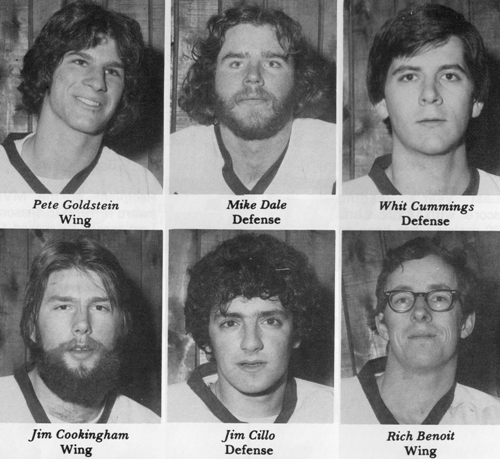
...well, except for Rich Benoit.

The December 14, 1976 Daily Collegian, unfortunately, only gives the events of that Sunday evening in Allentown a gloss-over treatment in the back half of an article also covering a 4-3 win at Delaware the day before the game with LU.


The Lions were involved in another close game against Lehigh but failed in a comeback bid and were defeated 7-5.

"After a strong second period we tied the score 3-3 and thought we could keep the momentum going in the third period," [head coach Bob] Hettema said. "We thought we were going to take over and skate them into the ice but instead we began to tire."

The Lions did appear to be taking the momentum away from Lehigh when Tom Horgas scored the go-ahead goal at 1:18 in the final period. But when Lehigh matched that goal a few minutes later, the partisan crowd spurred the Engineers on to victory.

Bill Richardson was in goal and stopped 42 shots. The Lion attack was balanced with Jerry Fry, Terry Brownschidle, Jim Lynch, Tom Horgas and [Bill] Galli scoring.


Lehigh, helped by the come-from-behind win, finished 11-5-0 that season, including a 6-4 win at Penn State in a rematch on January 23, 1977. In a situation mirrored by Northeast PA neighbor Scranton during its failed NCAA DIII run two decades later, the Engineers' schedule was an odd mish-mash of club teams like PSU, Delaware and West Chester, as well as varsity programs including Fairfield, Iona and Cortland State. Arguably, LU's most impressive results were 9-2 and 11-1 trouncings of RIT on February 19th and 20th, 1977. The Tigers, now an NCAA DI program of course, would go on to win national championships in 1983 (DII) and 1985 (DIII).

After 1976-1977, Penn State and Lehigh met five more times over the next few years, with the Icers finding increasing amounts of success, starting with the schools splitting a pair of meetings in 1977-1978. PSU then won at the Ice Palace on February 16, 1980, and twice more at the first two Nittany Lion Invitational Tournaments at the then-new Ice Pavilion on February 13, 1982 and January 21, 1983. The scores of those NLIT meetings were 7-4 and 12-3, a far cry from just a few years earlier when the Engineers were too steep of a hill for Penn State's puckmen.

The sudden reversal of results, unfortunately, said as much about Lehigh as it did about Penn State. By the end of the 1985-1986 season, and due to "the tension of Title IX compliance and other financial pressures [i.e., division adjustment, staffing and recruiting, league affiliation, travel and arena]," the program "faded from the athletics department’s agenda." The Icers wound up with a 4-6-1 record against LU's varsity hockey experiment.

Five years later, in 1991, the school rebooted with a club program and played one of their first games on November 3rd of that year at the Ice Pavilion against an Icers team well established as one of the giants of non-varsity hockey by that point. Predictably, Penn State cruised to a 9-1 win in what stands as the last tilt between the Icers and LU. Scott Shell had a hat trick that night, supported by two Mark Konchar goals and a 3-on-5 shorty by Brad Russell.

That Lehigh program, now unfortunately called the Mountain Hawks, has continued to develop over the last 22 years. It joined the ACHA in 1996, increased its budget several times over, and grew its association with a now-cooperative athletic department. This past season, while playing in the ACHA Division 1 ECHA - a conference that, by the way, includes Penn State Berks - LU went 15-13-1 under first-year coach Tom Laessig, the father of Ice Lions alumnus T.J. Laessig and rising Ice Lions junior forward Neil Laessig.

Although it took a couple generations, the demise and rebirth of hockey at both institutions, and several other dramatic shifts in circumstances, it appears that Penn State and Lehigh finally have a relationship worthy of their proximity and respective histories.